


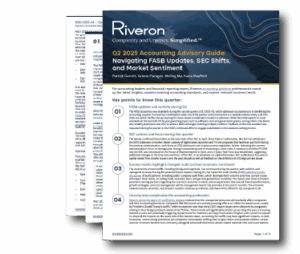
For accounting leaders and financial reporting teams, Riveron accounting advisory professionals round up the latest insights, examine evolving accounting standards, and explore relevant business trends.
Key points to know this quarter:
- FASB updates and activity during Q2: The FASB issued two new standards during the second quarter, ASU 2025-03, which addresses inconsistencies in identifying the accounting acquirer in a business combination when one of the parties to the transaction is a variable interest entity, and ASU 2025-04, which clarifies the accounting for share-based consideration issued to customers. While the FASB expects to issue standards in the back half of the year governing topics such as software costs and government grants, among others, the Board also notably proposed a new ASU to address debt exchanges involving multiple creditors. Feedback on the new standard was requested during the quarter in the FASB’s continued effort to engage stakeholders in the standard-setting process.
- SEC actions and focus during the quarter: The Senate confirmed Paul Atkins as the new chair of the SEC in April. Since Atkins’ confirmation, the SEC has withdrawn the 2019 statement on broker-dealer custody of digital asset securities and 14 rule proposals that had been put forth during the previous administration, with focus on ESG disclosures and cryptocurrency regulation, further indicating the current administration’s focus on deregulation through streamlining and re-evaluating current rules. A measure to fold the PCAOB into the SEC was introduced in the House of Representatives in April, and a Crypto Task Force was established, suggesting additional changes to the structure and focus of the SEC. In an emphasis on capital formation, SEC publications focused on capital raised from smaller issuers over the past decade as well as feedback on the definition of a foreign private issuer.
- Survey results highlight changed audit partner economic sentiment: The uncertainty around tariffs, including timing and magnitude, has continued during the quarter, with auditors and management teams bracing for potential future impacts. During Q2, the Center for Audit Quality (CAQ) published results of a survey of audit partners at leading public company audit firms, which illustrate their concerns over how current issues will impact their clients, including trade, recession fears, and general geopolitical instability. The results also show increased pessimism among partners regarding the country’s economic outlook, and an expectation that overall financial performance, growth strategies, and cost management will be management teams’ top priorities in the next 12 months. The economic outlook remains uncertain, and investor caution continues as a theme, with fewer IPOs offered in Q2 compared to Q1.
- Uncertainty complicates the accounting profession: Reports about the latest US tariff policy updates indicate that the unexpected pressures will markedly affect companies and their accounting functions. Companies like McCormick are actively pursuing efforts to “offset increased costs caused by President Donald Trump’s tariffs,” while economists note that early 2025 import surges were distorted by companies rushing to buy foreign products ahead of tariff hikes. These trends will significantly impact accounting this year, increasing inventory costs and potentially triggering impairments for inventory and long-lived assets if higher costs cannot be passed on. Beyond the impacts on the asset side of the balance sheet, accounting for tariffs may have significant impacts on debt covenants, restructuring provisions (as companies contemplate shifting their supply chains and evaluate whether certain revenue contracts become loss contracts), alongside enhanced disclosures about related material risks and uncertainties.
1. Accounting Standards Updates
ASU 2025-02 – Removes SEC guidance on obligations to safeguard crypto assets in response to SAB 122
The FASB issued ASU 2025-02 in March 2025, in response to the SEC issuing SAB 122 effective January 2025. Prior to SAB 122, companies safeguarding crypto assets for their customers were required to recognize both a liability and a corresponding asset on their balance sheets, measured at the fair value of the underlying crypto asset. With the issuance of SAB 122, reporting entities are no longer required to recognize a liability associated with the safeguarding of their customer’s crypto assets. Prospectively, entities with a safeguarding obligation for crypto assets should assess whether they have any loss contingencies under ASC 450, Contingencies.
ASU 2025-03 – Clarifies accounting acquirer determination in the acquisition of a variable interest entity (VIE)
Under current GAAP, in a business combination in which the legal acquiree is a VIE, the primary beneficiary of the VIE is always the accounting acquirer. The previous rule will be eliminated when the new ASU issued in May 2025 goes into effect. Under the new ASU, companies are required to consider the general factors in ASC 805-10-55-12 through 15 in determining the accounting acquirer when the acquisition of a VIE that is a business, is primarily affected by the exchange of equity interests. This ASU does not change the rule for acquisitions of VIEs that are not a business or not achieved primarily through the exchange of equity interests.
ASU 2025-03 is effective for all entities for annual and interim periods beginning after December 15, 2026, and early adoption is permitted.
ASU 2025-04 – Clarifies guidance on share-based consideration payable to a customer
ASU 2025-04 was issued in May 2025 to clarify the guidance under ASC 606 and ASC 718 on the accounting for share-based payment awards issued by an entity as consideration payable to a customer. This ASU is intended to reduce diversity in practice when determining whether the vesting conditions of the share-based payment awards are performance or service-based, and the update addresses concerns over mismatch of reduction in revenue even if awards are not probable of vesting. The ASU:
- revises the definition of a performance condition,
- eliminates the forfeiture policy election for awards granted to customers, and
- clarifies the interaction between ASC 718 and ASC 606 for variable consideration.
It is expected that entities will conclude that more awards contain performance conditions under the new ASU. For awards that are determined to have service conditions, the ASU eliminates the policy election permitting a grantor to account for forfeitures as they occur. Therefore, when measuring share-based consideration payable to a customer that has a service condition, the grantor is required to estimate the number of forfeitures expected to occur. Separate policy elections for forfeitures remain available for share-based payment awards with service conditions granted to employees and non-employees in exchange for goods or services to be used or consumed in the grantor’s own operations.
Grantors can apply the ASU on either a modified retrospective or a retrospective basis. ASU 2025-04 is effective for all entities for annual and interim reporting periods beginning after December 15, 2026, and early adoption is permitted.
Upcoming activity of the FASB
Five proposed ASUs are in the final stages of being drafted and voted on by the FASB Board. Four of the ASUs are anticipated to be issued in Q3 2025, with the last one expected in Q4 2025. The anticipated ASUs cover:
- Software Costs (Topic 350)
- Credit Losses on Purchased Financial Assets (Topic 326)
- Derivatives and Hedging (Topic 815)
- Interim Reporting (Topic 270)
- Codification Improvements (various topics)
To identify future priorities, the FASB has also issued an invitation to comment on the broader standard-setting agenda, and responses are due June 30, 2025. Riveron will participate in the agenda consultation process by issuing a response letter highlighting accounting issues related to definition of a business, troubled debt restructuring, equity method investments, revenue recognition, and current expected credit losses (CECL).
Feedback provided to the FASB in recent comment letters
Advocating on behalf of the office of the CFO, Riveron regularly provides comment letters to the FASB during open feedback periods. The FASB relies on the input of practitioners and financial statement stakeholders who are familiar with the day-to-day accounting challenges and opportunities faced by CFOs and accounting leaders. Explore details and expert considerations for various recent comment letter topics, including:
- Comment Letter on Proposed Accounting for and Disclosure of Intangibles
- Comment Letter on Debt Exchanges Subtopics 470-50 and 405-20
- Comment Letter on the Proposed ASU for Environmental Credit Programs
- Comment Letter on the Proposed ASU Topic 832: Government Grants
2. Regulatory Updates
SEC solicits public comment on the foreign private issuer definition
On June 4, 2025, the SEC published a concept release soliciting public comment on the definition of foreign private issuer.
- Foreign private issuers benefit from certain accommodations and exemptions from the disclosure and filing requirements of the federal securities laws. The concept release solicits public input on whether the definition of foreign private issuer should be amended in light of significant changes in the population of foreign private issuers since 2003.
- Remarks underscored a desire to balance the appeal of US markets for foreign companies with the need for investor protection and fair competition: “Attracting foreign companies to US markets and providing US investors with the opportunity to trade in those companies under US laws and regulations remains an objective. That objective must be balanced with other considerations, including providing investors with material information about these foreign companies, and ensuring that domestic companies are not competitively disadvantaged with respect to regulatory requirements.” said SEC Chair Paul S. Atkins. “The first step in striking this balance is to determine which foreign companies should qualify as foreign private issuers and be able to avail themselves to the accommodations that go with that status.”
In this concept release, the SEC is welcoming comments on the current foreign private issuer definition as well as on the costs, burdens, or benefits that may result from possible regulatory responses. The public comment period will remain open for 90 days following publication of the comment request in the Federal Register.
House Committee on Financial Services considers PCAOB defunding
A potential measure was introduced in the US House Committee on Financial Services on April 25, 2025, under which the PCAOB would be defunded and its activities would be transferred to the SEC. The duties transferred “would include the PCAOB’s inspections and enforcement activities involving firms that audit listed companies, as well as rulemaking and standard-setting activities,” no later than one year after the enactment of the act. The AICPA released a statement on May 1, 2025, stressing that the AICPA is prepared “to assist policymakers as they consider potential changes to the regulatory infrastructure overseeing public company auditing.”
As of late June, the legislative proposal to eliminate the PCAOB by merging it into the SEC has faced a significant procedural obstacle in the Senate due to the Byrd Rule. This rule mandates a 60-vote threshold for passage, making its immediate success highly improbable and reducing the likelihood of the PCAOB being defunded through the current legislative effort. Despite this, passage remains technically possible if sufficient bipartisan support were to emerge. Proponents could also pursue the measure through alternative legislative paths, or the SEC might administratively weaken the PCAOB, which could limit audit oversight or enforcement measures.
SEC data sheds light on capital raising and private fund trends
On May 28, 2025, the SEC published data on Regulation A, crowdfunding offerings, and private fund beneficial ownership concentration. Key insights are as follows:
- Over the past decade, there were more than 1,400 offerings seeking an aggregate of more than $28 billion in capital via Regulation A. Approximately $9.4 billion in proceeds was reported by more than 800 issuers.
- In the crowdfunding market between May 16, 2016, and December 31, 2024, there were more than 8,400 offerings initiated by more than 7,100 issuers. In the aggregate, the maximum amount sought in these offerings was approximately $8.4 billion.
- Over the period from 2013 to 2023, concentrated funds exhibited faster growth than unconcentrated funds. Concentrated funds hold more liquid assets and offer more liquidity to investors relative to unconcentrated funds, though both portfolio and investor liquidity have declined over the period.
The growing prominence of Regulation A and crowdfunding offerings signals a shift toward more diverse and accessible capital-raising avenues, particularly for emerging companies. This requires the accounting profession to adapt by developing expertise in the unique reporting, compliance, and valuation complexities associated with these less traditional funding mechanisms. For the Office of the CFO, these trends suggest an expanded strategic role in evaluating alternative financing options, managing heightened investor relations with a broader base, and ensuring robust internal controls and transparent financial reporting to satisfy diverse stakeholders and navigate potential liquidity shifts in both public and private markets.
Continued SEC focus on cryptocurrency
The US Senate recently confirmed Paul Atkins as the new chair of the SEC, officially sworn in on April 21, 2025. Following his confirmation, the SEC continued shifting its stance on crypto assets and regulations:
- The SEC announced on May 16, 2025 that it is withdrawing its July 8, 2019, statement on broker-dealer custody of digital asset securities, effective immediately.
- On June 2, 2025, the staff in the SEC’s Division of Corporation Finance released a statement expressing the view that protocol staking activities are not subject to the Securities Act of 1933 for registration purposes because they “do not involve the offer or sale of securities” as part of its broader effort to clarify current regulations pertaining to crypto assets.
- The SEC held three roundtables from April 28, 2025 through June 9, 2025 addressing the regulation of crypto assets. During the final roundtable, the SEC Chair further stressed the importance of blockchain technology, signaling a continuing move toward acceptance of cryptocurrency and related infrastructure by the SEC.
3. Other Insights and Webinar Replays
In case you missed it, explore our previous insights and webinar replays:
- Previous accounting advisory insights are summarized in our Q1 2025
- Finance and accounting teams can prepare for unpredictability amid tariff and trade pressures.
- Considerations for selecting the right independent auditor and the essential role of accounting when preparing for an IPO.
- Riveron experts regularly host webinars for accounting and financial reporting professionals, and many sessions offer CPE credit to live participants. Sign up for our newsletter to be notified about future Riveron webinars, including an upcoming mid-year outlook for accounting professionals.
This update provides general information and insights – consult with your advisors for specific guidance.