Don’t solve a liquidity crisis with a tax burden – structure liability management exercises (LMEs) with long-term value creation in mind.
IPO readiness has evolved beyond a technical-accounting exercise into an enterprise-wide transformation to public-company standards. Companies that navigate the process most efficiently begin operating like public companies months before filing.
The IPO process often exposes existing issues, especially in accounting and finance functions. Historical accounting decisions, governance practices, KPI definitions, financial reporting structures, complex contracts, and related-party transactions that received limited scrutiny as a private company often become the issues that determine the pace and success of the IPO process. When organizations underestimate the scope of the public-company uplift, the consequences compound throughout the IPO process, leading to longer review cycles, increased SEC comment letters, and greater auditor coordination challenges.
Successfully navigating that transition requires more than technical compliance. Finance leaders must establish a financial architecture that accurately reflects the business, build a defensible KPI strategy, and align stakeholders across Finance, Legal, FP&A, Sales, Investor Relations, executive leadership, and the Board before drafting begins. While AI is accelerating peer benchmarking, research, and disclosure preparation, it cannot replace management judgment. Critical decisions surrounding MD&A, accounting positions, and disclosure assumptions remain the responsibility of experienced finance leaders.
14%
of LME participants avoided subsequent default or bankruptcy (2)
22%
avoided both bankruptcy and re-default within two years of an LME (3)
~57%
lower first-lien recovery rates at LME companies that subsequently defaulted, vs. non-LME issuers (4)
Sources:
(1) CreditSights by Fitch Ratings, US Liability Management Transactions: Quarterly Update
(2) S&P Global Ratings, tracking 35 companies across 38 LMEs, mid-2017 through August 2024
(3) Harvard/Oxford study of 89 coercive, non-pro-rata LMEs (2026); 56% had already filed for bankruptcy within two years
(4) Fitch Ratings, 2024
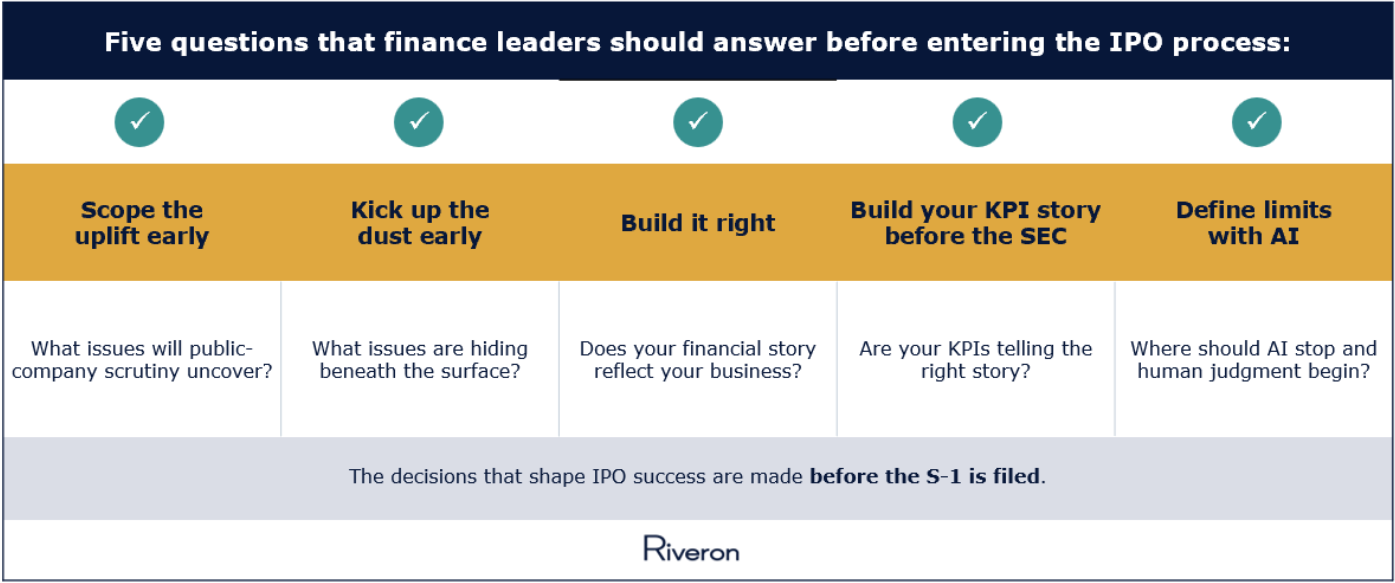
1. Scope the uplift early: The queue position you lose is the one you can’t get back
IPO windows open and close quickly, but the most effective IPO-track companies are those that enter the process fully clear on the expedients they qualify for and the related uplift that will be necessary, especially within the accounting and finance organization. Companies that get their scope wrong spend the registration period playing catch-up on work that should have been done months earlier, while those that enter the process with a clear understanding of the work ahead avoid costly surprises later. In fact, IPO readiness efforts can begin 12 to 18 months before the intended offering, making early assessment critical to protecting the filing timeline.¹
Assessing public-company readiness starts with foundational reporting considerations, including Emerging Growth Company (EGC) eligibility, Smaller Reporting Company (SRC) status, and the related disclosure requirements. It also requires cataloging material contracts, related-party relationships, historical accounting judgments, and policy elections that will face greater scrutiny under public-company standards. If an auditor transition is anticipated (for instance, moving from a mid-sized audit firm to a Big Four firm), companies should expect new engagement teams and Engagement Quality Review (EQR) reviewers to revisit previously settled conclusions.
Several trends reinforce the importance of mapping these requirements early:
- Public markets are showing renewed receptivity to new issuers, creating a limited window for companies that are prepared to move; advisory pipelines are accelerating.
- Companies that used the quieter market period as a readiness runway are entering the IPO process better positioned.
- Underestimating public company readiness requirements can lead to longer IPO timelines, more comment letters, and greater auditor alignment challenges.
- EGC eligibility, SRC status and accommodations, and the resulting disclosure architecture should be understood at the outset, rather than being determined during the process.
When taking a company public, lost time is difficult to recover. Companies that discover that deferred contract reviews or related-party analyses need to be performed, or policy decisions need to be made during the registration process are forced to play catch-up, while better-prepared issuers continue moving forward.
2. Kick up the dust early: The areas most often deferred
Many IPO delays stem from accounting issues that were acceptable or deferred as a private company but cannot withstand public-company scrutiny. These issues often surface when a Big Four auditor, new EQR partner, or SEC reviewer applies a higher level of rigor, making it critical to identify them before the S-1 process begins. Public-company audit requirements can also result in additional testing of accounts previously considered immaterial and renewed scrutiny of accounting conclusions that had already received sign-off.¹
Common areas include:
- Revenue contracts and side letters. Public-company auditors may challenge performance obligations, variable consideration, and contract modification conclusions, and the accompanying documentation, more closely than under a private-company audit.¹ Documentation that was sufficient as a private company may not meet public-company expectations.
- Related-party relationships. Completeness is a recurring uplift gap: Founders, investor-affiliated vendors, and portfolio-company cross-relationships should be identified, documented, and disclosure-ready before the audit begins.
- Historical accounting judgments. AICPA areas, such as complex equity arrangements, stock compensation for private-company instruments, impairment testing, and lease classification edge cases that received limited attention under private-company materiality thresholds may require reassessment and additional disclosure under public-company standards.
- Auditor transitions. Moving from a mid-sized firm to a Big Four auditor introduces new partners, EQR reviewers, and national-office scrutiny that can reopen previously settled conclusions. Auditor independence issues identified late can also require changes to the audit approach or, in some cases, a change in auditor, creating significant delays to the IPO timeline.¹
These areas may not appear in the S-1 table of contents, but they’re often where IPO timelines begin to slip. Surface these matters early to give companies time to remediate documentation, align with auditors, and reduce execution risk before SEC review begins. Waiting to surface them during fieldwork will often lead to a comment letter, which can delay an IPO and add a lot of undesirable execution risk.
3. Build it right: Financial architecture is a business identity question
Financial architecture decisions, including how revenue is presented, how ARR bridges to GAAP, and how the business is described in the financial statements, define how investors understand and value the business. FP&A, Accounting, Sales, the C-Suite, and the Board often approach the business through different operational lenses, but the S-1 requires one consistent financial story. Reconciling those perspectives before drafting begins prevents rework and strengthens the credibility of the filing.
For technology companies in particular, the revenue-to-ARR bridge tests whether the organization is aligned on how performance will be measured, communicated, and valued by the market. Once that alignment is established, finance leaders should engage external auditors early to validate structural decisions and unresolved accounting conclusions before they become execution risks.
Several foundational decisions should be addressed early in the IPO journey:
- Align on income statement presentation under Reg S-X Rule 5-03(b) to ensure the business is consistently represented to investors, auditors, and internal stakeholders.
- Resolve the revenue-to-ARR bridge before MD&A drafting when going from private to public. Its implications extend from FP&A forecasting and Sales compensation to Board reporting and investor modeling. Pro forma financial statements and EPS presentation also require early cross-functional coordination.
- Maintain forecasting assumptions that are internally consistent, audit-defensible, and stress-tested across scenarios, rather than optimized for the roadshow narrative.
- Document key decisions with external auditors. Changes in the audit team, partners, EQR reviewers, or national-office involvement can bring new scrutiny to previously settled conclusions. Written alignment doesn’t eliminate that risk, but it can narrow it materially.
Financial architecture establishes the foundation for the audit, MD&A, and investor-facing materials. Getting these decisions right early reduces rework and helps the companies move through audit and SEC review with a more consistent and credible financial story.
4. Build Your KPI story before the SEC does
Well-defined KPIs do more than satisfy SEC disclosure requirements; they shape how analysts and investors understand and value the business. Metrics such as ARR, NRR, retention, and non-GAAP measures become part of the company’s investment story. Definitions that are inconsistent or unsupported by historical reporting can create both regulatory scrutiny and market uncertainty. KPI benchmarking should begin before MD&A drafting, with clear and consistent definitions established upfront that consider:
- Where have peers been challenged?
- How do we accelerate the benchmarking?
Effective benchmarking also means studying the journey and going beyond comparing today’s disclosures with those of peer companies. Finance leaders should identify three to five peer filers and review their KPI definitions, filing histories, and SEC comment letters. How peers changed their disclosures in response to SEC feedback can be more instructive than their current presentation alone.
Key areas to address include:
- Benchmark peer filing and comment-letter histories to understand how disclosures have evolved in response to SEC scrutiny. Companies that only look at the current state disclosure miss the lessons that were already paid for.
- Ensure non-GAAP measures receive appropriate prominence and maintain clear, auditable reconciliations to GAAP financials.
- Apply KPI definitions consistently across periods, filings, and investor communications to avoid discrepancies that trigger SEC follow-up.
- Pay attention to ARR, NRR, and retention metrics, where clear, consistent definitions are critical to supporting the company’s performance. Vague or shifting definitions invite multi-round correspondence and additional comment letter rounds.
Done right, KPI benchmarking can serve as a valuation lever, and it will help IPO-track companies avoid unwanted comment letters. Done early, it can strengthen how the market evaluates the business while reducing the risk of avoidable SEC comments and delays.
5. Define where AI ends and human judgment begins
AI is accelerating the front end of IPO preparation, from peer benchmarking and EDGAR research to disclosure review. It has redirected finance teams’ time toward the judgment-intensive decisions that determine the quality and credibility of the filing rather than focusing on efficiency tasks.
To realize those benefits, organizations need clear governance around where AI can accelerate work and where human accountability begins. Finance leaders should define, review, and sign-off protocols, determine which outputs require direct CFO or Controller approval, and maintain transparency around where AI is being incorporated across workstreams.
In practice, effective teams are using AI to accelerate research, benchmarking, and drafting, but they will validate every output against internal data, historical filings, and auditor expectations before it becomes part of the registration statement. This can be real and consequential for compressed IPO timelines—but only if teams act on the output, not just produce it. Some of the highest-risk outputs from AI-assisted preparation are in KPI and non-GAAP contexts: where language appears precise but has not been validated against internal data definitions, prior filings, or auditor expectations. SEC staff have shown no appetite for disclosures that are benchmarked to peers but inconsistent with the company’s own prior-period filings.
Some key considerations include:
- Validate AI-assisted outputs. Research, benchmarking, and drafting should be checked against internal data, historical filings, and auditor expectations, particularly for KPI and non-GAAP disclosures where precise language may not align with the company’s underlying definitions or prior reporting.
- Keep judgment-intensive decisions with experienced finance leaders. MD&A, revenue recognition, business combination valuations, lease classification, and going-concern evaluations require human judgment to avoid audit defensibility risk that underwriters and legal counsel will flag.
- Establish clear ownership for reviewing AI-assisted work. The CFO question is not: “Should we use AI?” but rather: “Where does AI output require human sign-off before it touches a filing, and who owns that review?” Teams without a clear answer to that question are accumulating audit risk they may not recognize until fieldwork begins.
- Maintain transparency regarding ownership. Define who reviews and approves AI-assisted work, and ensure audit committees, auditors, and legal counsel have appropriate visibility into where AI has been used. If the audit committee, auditors, or legal counsel don’t know which workstreams and outputs incorporate AI-assisted drafting, they cannot calibrate their review, and surprises in fieldwork become defensibility problems.
AI can help companies prepare faster, but it does not lower the standard for filing quality. Finance leaders who clearly define the boundary between automated output and human judgment can capture the efficiency benefits of AI without compromising accountability or credibility.
Implications for finance leaders
Many of the decisions that shape SEC review and investor confidence are made long before the S-1 is filed. For CFOs, readiness means aligning finance, legal, investor relations, leadership, and the Board around a consistent financial and disclosure narrative. Organizations that treat these priorities as enterprise-wide governance decisions rather than isolated finance workstreams are better positioned to reduce execution risk and build credibility with regulators, auditors, and investors alike. Ultimately, successful IPO preparation is about becoming a public company before filing like one.
Related Insights and Sources:
- The Critical Role of Accounting and Finance When Preparing for an IPO, Riveron.







/Passle/66b0e16610008cf7be5e944d/MediaLibrary/Images/2026-10-08-16-56-26-329-6ac7cb3ad97b203a10a925b9.png)
/Passle/66b0e16610008cf7be5e944d/MediaLibrary/Images/2026-10-03-00-55-19-320-6ac05277d064879f66efa174.png)