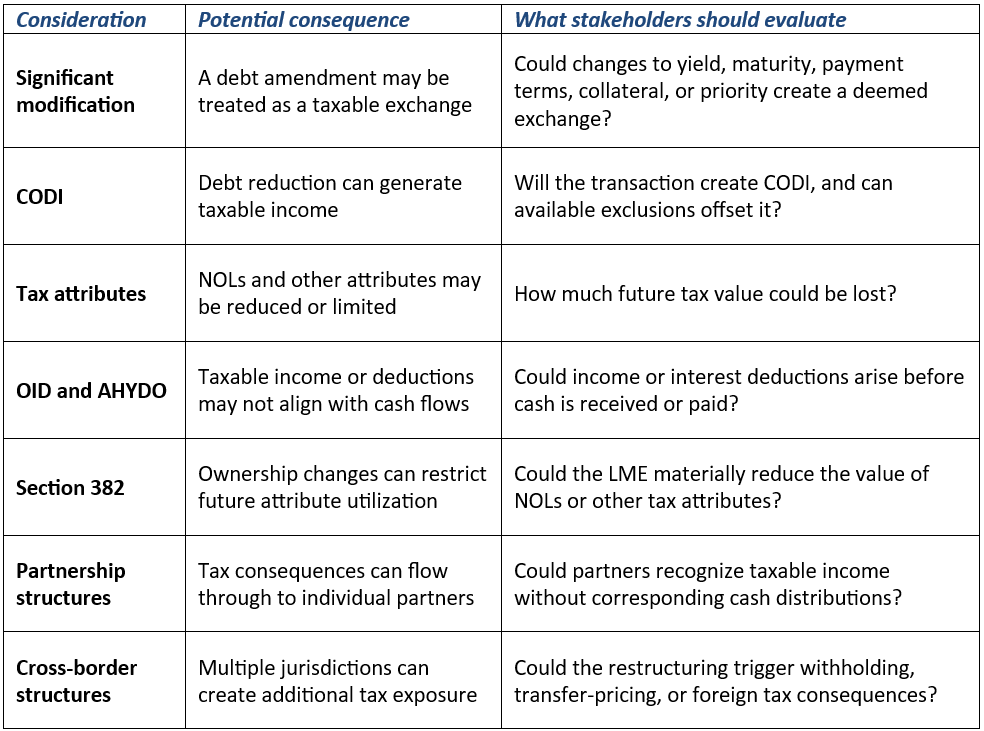
When an amendment becomes a taxable exchange
One of the first questions in evaluating an LME is whether changes to an existing debt instrument constitute a significant modification for tax purposes.
Treasury Regulation Section 1.1001-3 provides tests for determining when modifications are significant. Changes to maturity dates, interest rates, payment schedules, collateral, guarantees, or the obligor can all be relevant. Certain changes can independently cross the threshold, including a yield change exceeding the greater of 25 basis points or 5% of the original yield, payment deferrals beyond specified safe-harbor periods, changes in the recourse nature of an obligation, or changes in the priority of security interests.
If a modification is significant, the existing debt generally is treated as exchanged for a new instrument for tax purposes. That can create gain, loss, or CODI and require the new instrument’s issue price and debt-versus-equity classification to be determined.
The implication is important: a transaction that looks like an amendment from a commercial perspective may be a realization event for tax purposes.
A deemed exchange also resets the issue price of the debt, potentially based on fair market value or, for certain non-publicly traded debt, applicable rules under Section 1274. The resulting issue-price determination can affect CODI and the amount of OID included in the new instrument.
For transactions being negotiated under significant time pressure, these issues can be easy to overlook.
CODI can turn debt relief into a tax liability
In general, when a borrower satisfies or modifies debt for consideration worth less than the debt’s adjusted issue price, the borrower may recognize CODI. Discounted debt repurchases, debt-for-debt exchanges, debt-for-equity exchanges, and significant modifications can all create CODI.
For example, if lenders receive new debt with an issue price equal to 75% of the original principal amount, the reduction in issue price can generate CODI for the borrower—even if the transaction is intended to improve the company’s prospects and does not involve a conventional cash payment.
The issue becomes more complicated when debt is publicly traded. For tax purposes, the definition of publicly traded can extend to debt that is thinly traded or not registered with the Securities and Exchange Commission. In those circumstances, fair market value can play an important role in determining the issue price of the new debt.
Related-party transactions require additional scrutiny. Under Section 108(e)(4), purchases of a borrower’s debt by related parties can trigger CODI even when the debt is not acquired directly from the borrower and no cash changes hands between the borrower and an unrelated holder.
In a fast-moving restructuring, these distinctions can materially change the economics of an otherwise attractive transaction.
Debt-for-equity exchanges require careful valuation
Debt-for-equity exchanges can be an effective way to deleverage a balance sheet, but they make valuation particularly important.
Under the stock-for-debt exception in Section 108(e)(8), the amount realized by the borrower generally is based on the fair market value of the equity issued to creditors. That value is compared with the adjusted issue price of the debt being canceled.
If the company’s equity is worth less than anticipated at the time of the exchange, the transaction can generate more CODI than stakeholders expected. At the same time, the equity issued to creditors can contribute to an ownership change for purposes of Section 382.
The result is a trade-off that should be evaluated before the transaction is finalized. Increasing the amount of equity issued may help achieve the desired deleveraging outcome, but it could also affect the company’s ability to preserve tax attributes. Valuation is therefore not simply a negotiation input. It can be a critical tax variable.
Modeling multiple debt-for-equity structures and alternative exchange ratios can help stakeholders understand the relationship among leverage reduction, CODI, ownership changes, and the future value of tax attributes.
Tax relief today can reduce future tax benefits
The tax code provides exceptions that can allow certain borrowers to exclude CODI from taxable income, including bankruptcy and insolvency exceptions under Section 108(a), but excluding CODI does not necessarily eliminate its economic cost.
Instead, excluded CODI generally requires the reduction of certain tax attributes under Section 108(b). Those attributes can include NOLs, general business credits, minimum tax credits, capital loss carryovers, and asset basis. Under Section 108(b)(5), a debtor may elect in certain circumstances to reduce asset basis before reducing NOLs. This creates an important distinction between current tax relief and permanent economic benefit.
A company may avoid an immediate cash tax obligation by excluding CODI, but the corresponding reduction in tax attributes can increase its tax burden in future periods. For a business expected to return to profitability after a restructuring, the value of those attributes can be significant.
In an LME, the borrower’s level of insolvency is particularly important. CODI generally remains taxable to the extent debt relief exceeds the borrower’s insolvency. If available deductions and tax attributes cannot fully offset the resulting taxable income, the company may owe cash taxes in the current year, even if the LME does not ultimately produce a successful turnaround. That possibility makes tax-attribute valuation an important part of evaluating the true economics of debt relief.
Original issue discount (OID) can create a mismatch between taxable income and cash
OID can arise when debt is issued at a discount, includes payment-in-kind (PIK) features, or otherwise provides for deferred economic yield. The resulting tax consequences can create a mismatch between when income or deductions are recognized and when cash actually changes hands.
This issue is particularly relevant in distressed exchanges, where new debt may be structured to conserve cash through PIK features or other forms of deferred payment. Certain long-term, high-yield debt instruments can also fall within the applicable high-yield discount obligation (AHYDO) rules under Section 163(i). PIK toggle notes commonly used in restructurings can fall within these rules depending on their yield, issue price, and maturity.
If the AHYDO rules apply, interest deductions can be deferred until amounts are actually paid, and a portion of the deduction can be permanently disallowed and treated as a nondeductible dividend. For a company already managing constrained liquidity, the timing of these deductions can matter as much as their ultimate amount. New debt should therefore be modeled for OID and AHYDO exposure before pricing and terms are finalized.
Section 382 can limit the value of tax attributes
For companies with significant NOLs, deferred interest deductions under Section 163(j), R&D credits, or other tax attributes, Section 382 can be one of the most consequential considerations in an LME.
An ownership change resulting from a restructuring can substantially limit the company’s ability to use those attributes in the future. An ownership change generally occurs when the percentage of stock owned by one or more 5% shareholders increases by more than 50 percentage points over the applicable testing period.
In an LME, equity issued to creditors can contribute to an ownership change. Related options and warrants may also matter, and aggregation and segregation rules can cause smaller holdings to be relevant even when no individual creditor crosses the 5% threshold independently.
The resulting Section 382 limitation is generally based on the company’s equity value immediately before the ownership change, subject to specified adjustments. The valuation implications can be significant. A company may emerge from an LME with less debt but also with substantially less ability to use tax attributes that could have sheltered future income.
The out-of-court nature of an LME can make this issue even more important. Certain debtor-friendly Section 382 provisions available in a Title 11 or similar proceeding are not available in an out-of-court restructuring. These include the Section 382(l)(5) exception for certain qualifying creditor ownership changes and the Section 382(l)(6) rules that can increase the company’s equity value used in determining the limitation by measuring value after the debt relief transaction.
Where tax attributes represent meaningful future value, the legal form and structure of the LME may therefore be constrained by the need to avoid or manage an ownership change.
Partnership structures can create unexpected tax liabilities
Partnership structures introduce another layer of complexity because the tax consequences of a restructuring can flow through to individual partners.
Unlike a corporate borrower, a partnership does not generally determine the CODI exclusion at the entity level. Instead, each partner separately considers whether it qualifies for the bankruptcy or insolvency exclusion based on its own circumstances.
That can produce materially different outcomes among investors participating in the same restructuring. Attribute reduction likewise occurs at the partner level.
Other partnership provisions, including minimum gain chargeback and Section 704(b) capital account rules, can also create allocations of taxable or “phantom” income to partners who receive no corresponding cash distribution.
For sponsors and other investors, the result can be a cash-tax mismatch: a restructuring may improve the economics of the underlying business while simultaneously creating tax obligations for individual partners. These consequences should be evaluated alongside the partnership agreement and allocation provisions before an LME is implemented.
Cross-border restructurings add another layer of risk
For multinational groups, the tax analysis cannot stop with US federal rules.
An LME may affect withholding taxes, transfer pricing, hybrid instrument rules, foreign tax credits, and local debt-discharge regimes. A transaction that is efficient from a US tax perspective may create an adverse result in another jurisdiction.
Intercompany debt requires particular attention. Debt issued or amended as part of an LME can be recharacterized as equity under Section 385, potentially eliminating anticipated interest deductions and converting payments into nondeductible distributions subject to withholding tax.
Debt forgiveness involving a controlled foreign corporation can also create GILTI inclusions for US shareholders. In addition, a modification significant enough to create a deemed exchange may affect previously established portfolio-interest or treaty withholding exemptions.
For multinational borrowers, tax planning therefore needs to be coordinated across jurisdictions rather than performed independently by country or workstream.
Build tax analysis into the LME process
Tax analysis conducted after commercial terms have been negotiated can identify problems, but by then the available alternatives may be limited. Integrating tax analysis into transaction design from the outset gives stakeholders greater flexibility to compare structures and understand the trade-offs.
At a minimum, stakeholders should:
- Model alternatives. Evaluate the tax consequences of different exchange structures, exchange ratios, debt instruments, and ownership outcomes.
- Test issue-price assumptions. Determine how the issue price of existing and new debt affects CODI, OID, and the overall economics.
- Support valuations. Document fair market value assumptions that could affect CODI and Section 382 outcomes.
- Preserve tax attributes. Quantify the value of NOLs, credits, deferred deductions, and other attributes and assess how the transaction could affect their future use.
- Coordinate workstreams. Align tax, legal, accounting, and financial analyses because the tax outcome can depend on the transaction’s precise structure, valuation, accounting treatment, and timing.
- Model tax and cash flows together. GAAP and cash-tax outcomes can diverge materially, so tax modeling should run alongside the financial model.
Making the LME work for the business
An LME can provide a company with critical time and flexibility, but the transaction itself is not the turnaround. Its ultimate value depends on whether the company can use that flexibility to address the operational, financial, and strategic issues underlying the distress.
Ultimately, both the choice of an LME and its structure matter. Stakeholders must first determine whether an LME can support a credible path to value creation. They must then evaluate whether the proposed structure preserves as much of that value as possible.
Tax considerations are an important part of that analysis. CODI, tax-attribute limitations, OID and AHYDO rules, Section 382, and other tax consequences can materially change the economics of an otherwise attractive transaction.
By evaluating these considerations alongside the broader restructuring strategy, borrowers, sponsors, lenders, and their advisors can make better-informed decisions about whether to pursue an LME and how to structure one that supports the company’s longer-term objectives.
Related Insights
For a broader perspective on when an LME may be appropriate as part of a turnaround and value-creation strategy, read:
Rethinking LMEs: Financial Engineering Without Operational Reform Is a Path to Value Destruction