

In today’s unpredictable economy, manufacturing leaders and private equity investors are facing a pivotal moment. Supply chains are under strain from labor shortages, increased operating costs, sustainability imperatives, shifting geopolitical dynamics, and embracing innovation via new technologies like AI. In addition, changes to US trade policy will likely affect supply chains and spur companies to significantly redefine their sourcing strategies, network footprints, and overall operating cost structure.
Explore a related webinar
Join Riveron experts for the March 2025 webinar, Planning for Unpredictable Tariff & Trade Pressures.
This year will require careful planning to build a company’s resilience and meet growth aspirations related to EBITDA — especially for mid-to-large manufacturing organizations and those with the complexities of being private-equity-backed.
In 2025 and beyond, manufacturing business leaders — including CFOs, COOs, and any private equity sponsors — will need to rethink supply chain strategies, accelerate sustainability plans, address continued workforce shortages, and combine operating discipline with innovation.
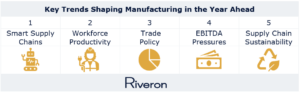
Here are the key trends, opportunities, and considerations that can help your manufacturing business prepare for economic unpredictability and solve the latest supply chain challenges:
MANUFACTURING INDUSTRY TREND 1
Smart supply chains: Unlocking margins and working capital efficiency
Tackling disruptions and elevated operating costs with agility, innovation, and efficiency. Key areas of focus for manufacturers and private equity investors in the near future include:
- Business scenario simulation using analytics and generative artificial intelligence (Gen AI)
- Sourcing and demand forecasting via AI-powered tools, which can help manufacturing businesses leverage real-time data and analytics to improve cost and inventory management.
- Smart connected factories powered by IoT, AI, ML and robotics to enable enhanced productivity.
Results you should expect from investing in a smart supply chain:
Recent industry benchmarks indicate that a smart factory increases portfolio valuation by one to two times EBITDA. By investing in smart supply chain technologies, manufacturing leaders can enable enhanced timely, data-driven decision making along with insights that will improve a manufacturing organization’s overall productivity, asset reliability, and enterprise profitability.
MANUFACTURING INDUSTRY TREND 2
Workforce: Reducing costs and improving productivity
Today’s manufacturers face a two-fold labor challenge: (1) managing an aging workforce and (2) empowering a workforce with the necessary skills to embrace technologies and drive innovation. To that effect, a few key initiatives must be considered by organizations and their leaders—as well as investors—to ensure cost savings and higher productivity:
- Digitized work processes, including automation and robotics
- Upskilling of the current workforce related to AI and other technologies
- Talent acquisition and retention strategies
- Hiring resources with more science, advanced technological, engineering, and mathematics skills
- Foreign worker visa sponsorship
Talent retention strategies are paramount for an effective workforce, and manufacturing organizations will be most successful when they align employee rewards and incentives with performance scorecards and the market. Manufacturing leaders should ask themselves: are the employees enabled with the right tools and processes to do their jobs successfully, and is the company culture also empowering and reinforced from the top down? These factors all contribute to favorable employee retention.
Results you should expect from new manufacturing workforce investments:
Workforce-related investments can provide insights into actions that can lead to better profitability stemming from improved workforce productivity and higher morale. By investing in the workforce, a manufacturing organization can avoid high turnover rates, which negatively affects team performance and overall company performance. Ultimately, strong employee retention reduces turnover-related costs (such as staffing agency fees and training costs) which can have an unfavorable impact to operating costs.
MANUFACTURING INDUSTRY TREND 3
Trade policy: Protecting margins
With a new administration in the White House, tariffs on select US imports may rise significantly, which will increase operating costs, disrupt global supply chains, and impact geopolitical stability. CFOs, COOs, and supply chain leaders can mitigate those risks by considering some key levers:
- Manufacturing and distribution network optimization (nearshoring, onshoring)
- Strategic sourcing and supplier management
- Pricing/commercial strategies
- Harmonized tariff code engineering
- Trade preference/duty optimization programs
- M&A trade risks assessments
- Finance/cash flow impact and planning
- Global transfer pricing and cash management strategies
Tariff unpredictability is about protecting margins and managing costs, especially related to imported products. When tariff or trade pressures arise, some companies will have to absorb those costs or decide to pass along the costs to customers, which can negatively affect sales or brand loyalty.
Results you can expect from adjusting key levers related to trade policies and protecting company margins:
As manufacturers manage costs-per-unit and pricing strategies with their customers, it will eventually have a positive impact on overall EBITDA margins. It’s also important for manufacturing leaders to anticipate potential supply chain disruptions. These forces can spur companies to revisit or revamp their on-shoring/off-shoring models, which will affect working capital.
MANUFACTURING INDUSTRY TREND 4
EBITDA pressures: Focusing on manufacturing fundamentals
While innovative technologies are transforming today’s supply chain & operations, manufacturers should ensure that their key manufacturing fundamentals are fully mature to enable a successful digital transformation. These changes can allow a company to truly step up its performance, leading and competing well in the market. Manufacturing fundamentals include:
- Aiming toward operational and supply chain excellence
- Optimizing the organizational structure by placing the right people in the right positions
- Driving process and continuous improvements initiatives to ensure work standards are fully mature, enabling sustainable performance
- Training workers and enhancing the capabilities of the people at your manufacturing company
- Identifying and addressing key risks and mobilizing strategies to support resiliency
In manufacturing, appointing individuals to the right roles can be a common challenge that is often intertwined with ensuring efficient processes. For example, scenarios often happen in which the best mechanic is promoted to a supervisory role within maintenance, and the individual isn’t suited to a management role. Further, the company’s best mechanic role is then vacant. To be more effective, leaders have to look at the overall organizational structure and make sure it’s right; then, manufacturing leaders need to appoint the right people (enabled by the right tools and training) to fall within those roles. If the right organizational structure isn’t in place, even if the processes are good, then a company might have one person doing three jobs. Leaders can avoid these pitfalls by ensuring managers can adequately oversee and lead their teams and that individual contributors and specialists are plugged into the right roles.
Results you can expect from reimagining processes:
With the appropriate processes and organizational structure in place, manufacturing productivity can increase. Managers can also be enabled by timely, insightful decision-making, which, in turn, increases productivity across the organizational structure.
MANUFACTURING INDUSTRY TREND 5
Sustainability in the supply chain: Reducing operating and compliance costs
Sustainability is becoming a business priority for manufacturers as they balance short-term costs with long-term resilience, meet regulatory demands, and integrate environmental responsibility into their core strategies. Due to this, business leaders can expect to see a strategic switch towards:
- A more intentional use of renewable energy and recyclable materials
- Reductions in emissions, excessive packaging, and water consumption
Results you should expect from bolstering supply chain sustainability:
Going green will affect energy savings in manufacturing; recycling/recycled content helps with operating costs which will also have an impact on pricing, which allows the company to have a competitive advantage by offering lower costs to customers. A sound environmental, social, and governance (ESG) agenda also helps organizations avoid compliance costs (fines for non-sustainable practices).
Need supply chain guidance for the year ahead?
Today’s CFOs and operations leaders can benefit from expert guidance to address supply chain resilience, tariff-related disruption, and more. Working with you to tackle the most pressing needs of each business, the Riveron advisors can guide your organization across several areas of expertise, including:
- Supply Chain Strategy and Execution, including SKU profitability, network design, strategic sourcing, manufacturing excellence, digital manufacturing transformation and inventory strategy
- Global Trade and Tax advisory, including trade preference optimization, HS code optimization, transfer pricing / cash management and regulatory technical guidance
- Financial Planning and Analysis across cash forecasting, financial modeling, budgeting and long-range strategic planning
Explore our related offerings: Supply Chain | Tax Advisory | FP&A | All Services
Connect with Riveron
We partner with our clients and their stakeholders to elevate performance and expand possibilities across the transaction and business lifecycle. Contact us to learn more.