
The powerful simplicity of the 3S Model and the 13WCF might make them seem like obvious financial tools, but, in practice, it’s surprising how often they are entirely overlooked or severely underutilized in isolation.
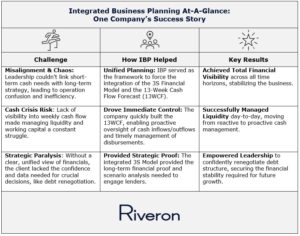
Finance and operations leaders are facing an increasingly chaotic and complex business environment where converting long-term strategy into effective action is a constant challenge. This difficulty arises because core functions often fail to communicate, leading to costly inefficiencies and slow, poor decisions. Integrated Business Planning (IBP) solves this by unifying planning across all key business areas into one cohesive vision. While concepts and core processes / data models used in IBP aren’t new, they are frequently overlooked or used only partially without this vital integrated approach. Examining one Company’s success story shows how IBP transforms complexity into a single focus, helping leaders stop guessing and drive powerful results.
Client Success Story: Why IBP Matters and How to Apply It
Many business leaders struggle because there’s a widening gap between long-term strategy and daily working capital and cash management. It’s possible to guide success, and we’ll examine a client story that shows how Integrated Business Planning connected finance and operations planning horizons. The Company was able to solve its immediate financial challenges while setting itself up for long-term growth.
You can apply this approach by ensuring your team links common tools like a Three-Statement Financial Model (your intermediate to long-term view of profitability) directly to your 13-Week Cash Flow Forecast (your week-to-week money plan). Doing this gives you complete financial visibility across your entire business. The ultimate goal is simple: You’ll be able to make faster, smarter decisions and prevent financial surprises, giving you the confidence to manage debt, invest in growth, and increase your company’s overall resilience.
Navigating Complexity with Integrated Business Planning
To enable IBP success, leaders need to establish consistent data models that are integrated across functions, with shared data elements and standardized definitions. Typically, five core data models underpin an effective IBP process:
Annual Processes:
- Strategic Plan (Long-term, 3-5 years)
- Annual Budget (Intermediate, 1 year)
Monthly Processes:
- Three-Statement Financial Forecast (Short- to Intermediate focus)
- Operational Forecast (Short- to Intermediate focus)
Weekly Process:
- 13-Week Cash Flow Forecast (Short-term focus)
Short-Term Cash Planning: Managing Liquidity with a 13-Week Cash Forecast
The 13-Week Cash Forecast (13WCF) is a short-term financial planning tool that projects the company’s weekly cash position over the next 13 weeks. It’s typically used by the Treasury or FP&A function to ensure that the company can meet its immediate cash needs. Depending on the current state of liquidity, the 13WCF can be rolled forward weekly or biweekly. To build and maintain an accurate 13WCF, all cash inflows and outflows over the forecast period must be accounted for. Examples of each include:
- Cash Inflows: Expected collections from sales (AR) and any other sources of income.
- Cash Outflows: Payroll, operating expenses (AP), capital expenditures, debt repayments, one-time items, taxes and insurance.
Biggest challenges faced in the 13WCF:
- Comprehensive cash visibility: Depending on the size of the business, it can be difficult to account for and forecast all major cash movements to avoid surprises.
- Timing of inflows: Timing of AR collections and cash inflows are more difficult to forecast than disbursements, as inflows are not directly controlled by the company.
- Outstanding check float: Disbursements paid via check have an added layer of complexity as checks are dependent upon a courier and timing of the vendor deposit.
The Strategic Value of the Three-Statement Financial Model in Forecasting & Planning
A critical enabler of effective medium- to long-term forecasting is the development of an integrated Three-Statement Financial Model (3S model)—a comprehensive framework that links the income statement, balance sheet, and cash flow statement into a single, cohesive structure.
This integration ensures that changes in key operational assumptions—such as sales volumes, production levels, or capital expenditures—are automatically reflected across all financial statements. The result is a more accurate, real-time view of financial performance that enhances transparency and decision-making.
The 3S model plays a central role in Integrated Business Planning by aligning operational activities with strategic financial outcomes. It allows organizations to simulate and evaluate multiple business scenarios, assess trade-offs, and make informed decisions based on profitability, liquidity, and capital efficiency.