

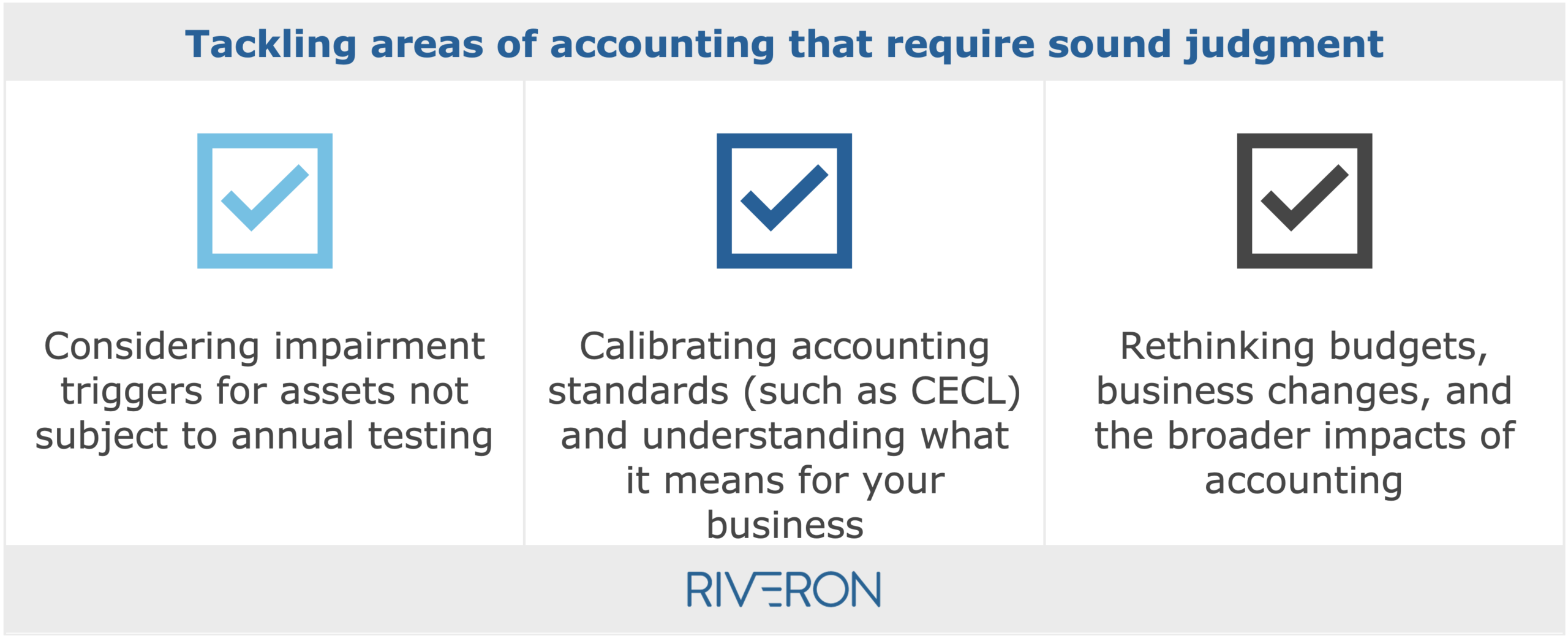
For corporate accounting professionals, navigating the complexities of financial reporting requires not only a firm grasp of technical accounting standards but also the ability to exercise sound judgment in situations where specific guidance may be limited. Some timely topics that accounting professionals may find challenging to navigate include impairment testing and new or recently implemented accounting standards such as CECL. Accurately accounting for new standards not only impacts a company’s audit readiness—it also plays an essential role in accurate budgeting, forecasting, and strategic decision-making.
A guide to judgment in impairment testing
Amongst the various complexities of technical accounting, impairment testing often presents unique challenges due to its reliance on estimates and subjective assessments. Annual impairment testing, as well as assessing impairment triggers for finite-lived assets, is sometimes overlooked but is important for most organizations, including private companies preparing for their annual audits. Accounting leaders should understand the intricacies of goodwill impairment, potential impairment scenarios, and how to tackle the “gray areas” with informed judgment.
Goodwill impairment and indefinite-lived intangible asset impairment each require sound judgment
Goodwill, an intangible asset representing the premium paid in an acquisition over the fair value of identifiable net assets, is particularly susceptible to both impairment and a significant amount of judgment. Similarly, indefinite-lived assets which typically represent intangible assets with useful lives that are assumed to exist in perpetuity, such as a tradename, represent a challenge when applying the guidance in ASC 350 regarding evaluation for impairment. While annual goodwill and indefinite-lived intangible assets may seem run-of-the-mill, significant judgment is required to determine the inputs utilized in the impairment test. Determining fair value often depends on forecasted cash flows, which like any estimates are inherently susceptible to unforeseen changes in the business environment. This inherent subjectivity calls for sound judgment by company management and invites scrutiny from auditors.
Poor performance in a reporting unit can indicate potential goodwill or indefinite-lived intangible asset impairment. The future cash flows used in the impairment test will require a detailed build of budgeted figures and an analysis of potential scenarios. A sensitivity analysis is a great way to determine the strength of the reporting unit in various scenarios and identify significant inputs that require further analysis. A sensitivity analysis such as a most-like scenario accompanied by a worst-case scenario and an upside scenario can help make clear the potential range of business outcomes and how they impact the impairment analysis.
What about finite-lived assets?
While often overlooked, assessing finite-lived intangible assets for potential triggering events should be the first step preceding the required annual impairment tests for goodwill and indefinite-lived intangible assets. A significant decline in a business unit’s performance can indicate potential impairment in other groups of assets. Finite-lived assets are tested in asset groups, defined as the lowest level for which there are identifiable cash flows that are largely independent of the cash flows of the other assets and liabilities. Potential triggering events indicated by ASC 360 include:
- A significant decrease in the market price of a long-lived asset (asset group)
- A significant adverse change in the extent or manner in which a long-lived asset (asset group) is being used or in its physical condition
- A significant adverse change in legal factors or in the business climate that could affect the value of a long-lived asset (asset group), including an adverse action or assessment by a regulator
- An accumulation of costs significantly in excess of the amount originally expected for the acquisition or construction of a long-lived asset (asset group); A current-period operating or cash flow loss combined with a history of operating or cash flow losses or a projection or forecast that demonstrates continuing losses associated with the use of a long-lived asset (asset group)
- A current expectation is that, more likely than not, a long-lived asset (asset group) will be sold or otherwise disposed of significantly before the end of its previously estimated useful life. The term more likely than not refers to a level of likelihood that is more than 50 percent.
How cash flow forecasting factors into impairment testing
As noted earlier, the fair value of goodwill and indefinite-lived intangible assets heavily relies on forecasted cash flows. If management has determined there is a triggering event for finite-lived assets, forecasted cash flows will be utilized in the recoverability test. Determining these cash flows involves making assumptions about future economic conditions, market dynamics, and the company’s competitive landscape. The ability to exercise sound judgment in selecting these assumptions and ensuring their reasonableness is crucial in determining the impairment loss, if any.
This highlights the importance of professional skepticism and a critical evaluation of the underlying assumptions and methodologies used in the cash flow forecasting process. Collaboration between management and external auditors becomes critical in ensuring that the chosen assumptions are sufficiently supported and represent a realistic view of the company’s future prospects.
Challenging the assumptions of third-party valuation specialists
When accounting for goodwill impairment, it can often be difficult to understand the methodology used by third-party valuation specialists. Sometimes these communications can be full of jargon or arranged in a way that isn’t intuitive, so company accounting leaders should be proactive and get clarity wherever needed. It can help to look at the prior-year analysis and inputs and compare what has changed year-over-year.
If the numbers don’t seem accurate (for example, if the cash flows are too heavily discounted), company accounting leaders can—and should—challenge the valuation specialists because the in-house team knows the business. This deep knowledge of the business supports a clear understanding of the relevant risks, cash flows, and other critical factors. A valuation specialist might not know the business as intimately as accounting management, so it’s important to use judgment to work in partnership with these professionals in order to support the findings with the most accurate assumptions.
Other impairment considerations beyond goodwill
While goodwill impairment may be a prominent example, it’s crucial to remember that the principles of impairment testing apply to various other asset classes. For instance, if a company experiences a significant and sustained decline in its market value, it might trigger an impairment test for long-term investments. Additionally, inventory obsolescence and deterioration can necessitate impairment tests for inventory assets.
Exercising accounting judgment with confidence
Impairment testing, particularly for goodwill, presents unique challenges due to its reliance on estimates and subjective assessments. By exercising sound judgment, leveraging professional skepticism, and fostering collaboration with auditors, corporate accounting professionals can navigate this area with confidence and ensure that their financial statements reflect a faithful representation of the company’s financial health.
Mastering CECL: honing judgment and approaches to this dynamic accounting standard
The Current Expected Credit Loss (CECL) standard brought a significant shift in credit loss recognition and measurement. While many accounting teams initially perceived the standard as a straightforward calculation, reporting for CECL relies on estimates and subjective assessments, which introduces complexities that demand informed judgment. Plus, accounting teams can benefit from revisiting their initial approaches to CECL to strengthen accuracy and ultimately support better decisions in the future.
CECL affects most companies, not just the financial services sector
While the financial services industry experienced the most significant impact from CECL, its reach extends far beyond. Any company extending credit, from retailers offering store credit cards to manufacturers providing financing options, even companies simply holding accounts receivable balances, must grapple with the standard’s implications. Applying CECL to these diverse scenarios requires tailoring the standard’s framework to specific business models and credit risk profiles, further emphasizing the role of judgment in navigating its nuances.
Beyond the numbers: The role of judgment in accounting for CECL
Unlike earlier standards focused on incurred losses, CECL requires companies to estimate expected credit losses over the entire life of the financial instrument. This inherently forward-looking approach necessitates the application of sound judgment across various aspects of the standard.
Accounting for CECL is complex because it requires incorporating qualitative factors alongside quantitative data. Factors like economic forecasts, industry trends, and historical loss patterns must be considered and weighed against each other, demanding professional skepticism and a critical evaluation of underlying assumptions.
Embracing the “best guess” and learning from hindsight
Determining the precise value of current expected credit losses can be akin to peering into a crystal ball. The inherent uncertainty requires CFOs and accounting professionals to use their best judgment, supported by historical data, industry benchmarks, and expert insights.
Hindsight can be a valuable tool in refining future estimates. Regularly reviewing the accuracy of past estimates allows for identifying any significant discrepancies between predicted and actual losses. This retrospective analysis helps in calibrating future assumptions and improving the reliability of estimates over time but may require a significant effort to understand historical trends, especially when receivables have only been reserved and not fully written off.