

When most businesses conduct a turnaround, restructuring, or performance improvement initiative, customer contracts are an essential factor. An objective, data-driven review of customer contracts is a high-priority task that is conducted during the assessment phase because it can significantly improve the financial performance of a business.
Since the onset of the pandemic, these customer contract reviews have received increased attention due to the dramatic transformation that has taken place in the operating environment resulting from inflation, manufacturers’ line rate reductions, supply chain disruptions, and labor constraints.
The contract review should look at both pricing and the terms and conditions of sale. The former is a relatively straightforward evaluation of profitability by part number, while the latter can be a much more onerous undertaking given the size, complexity, and interrelationships of the contracting documents used by most original equipment manufacturers (OEMs). An objective evaluation of the customer’s supply chain health and strategy, and how the company fits into it provides a backdrop for determining an appropriate negotiating strategy.
Why are contract changes front and center now?
Pre-COVID contracts don’t work.
Many of the contracts with OEMs and Tier-1 suppliers went into effect pre-COVID, and, since that time, the business and economic environments have changed dramatically. Commercial aircraft production rates, particularly at Boeing on all models, but also with Airbus widebody aircraft have dropped significantly, causing demand to decrease within the supply chain affecting profitability/free cash flow/overhead absorption at the factory level. At the same time, record inflation has affected many aspects of component cost structure, including raw materials, labor, outside processing, transportation, insurance, energy, etc. Said differently, contracts that made sense during the pre-COVID low inflation super cycle do not necessarily support a financially viable business today because they lack the flexibility to accommodate inflationary pressures and offer no beneficial treatment for suppliers should demand drop.
Supplier Bargaining Power
Suppliers have more leverage now than at any time in the preceding 20 years. Let’s face it, the commercial aerospace supply chain is not healthy. The super cycle saw a massive infusion of private equity capital into the market, which drove valuations into the stratosphere, and resulted in excessive debt on company balance sheets. As a result, many suppliers survived the COVID-related and Boeing 737MAX downturns but have been left with little credit availability to fund the working capital growth required for revenue growth. Moreover, raw material and labor shortages have made it challenging to conduct the transfer of statements of work between suppliers. Plus, many OEMs have well-publicized production and quality issues of their own. Put all those factors together and the last thing that customers want to do is move work from a supplier simply because that supplier is requesting modifications to pricing and terms & conditions of sale. They have bigger fish to fry and can’t afford to lose suppliers. In today’s context, contractual amendments are occurring much more frequently than before the pandemic.
Rethinking contracts: how aerospace businesses should approach the analysis
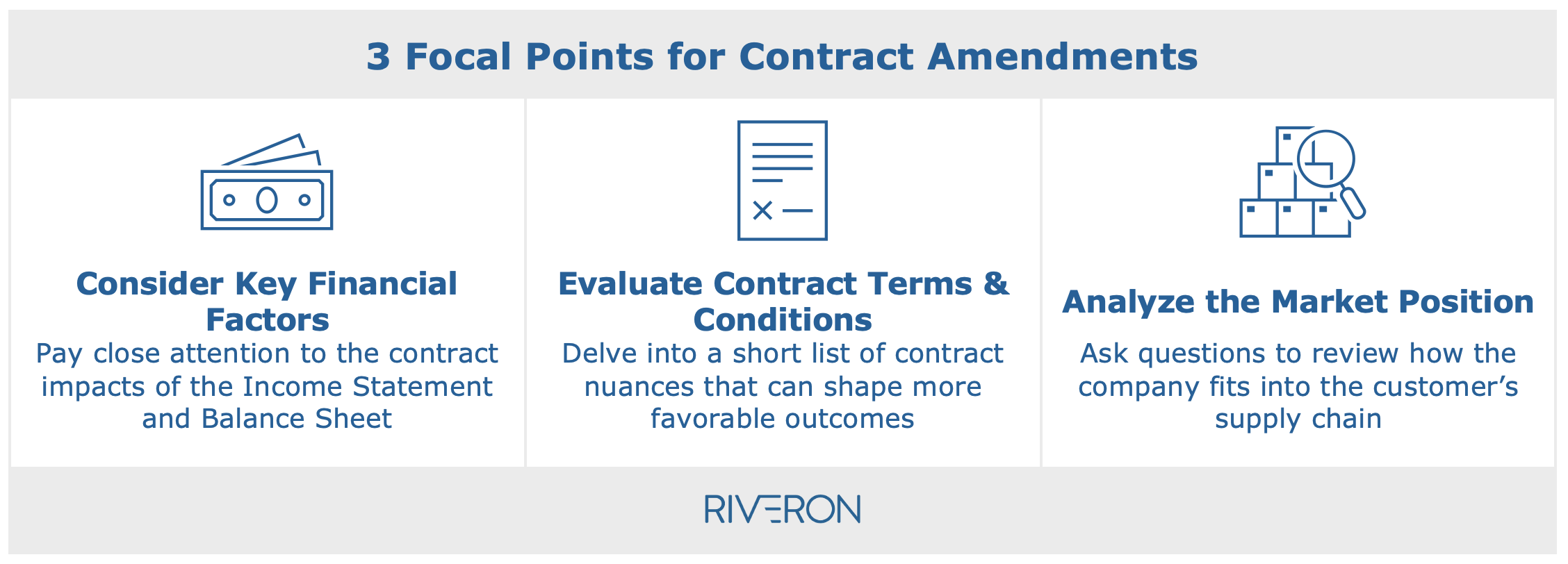
1) Consider Key Financial Factors:
Income Statement
The goal of a for-profit business should be to satisfy or exceed customer expectations profitably. To conduct the negotiation in a manner that maintains a positive relationship with the customer, a business needs to bring data and be transparent with it.
Whenever possible, conduct a profitability analysis by part number, program, and customer so that the business and finance leaders can consider how the requested changes will affect various constituencies within the customer, such as program managers, supply chain, legal, etc. The profitability analysis should look at direct costs (material, labor, outside services, scrap, re-work) as well as overhead and fixed expenses. Take an honest look at how much of the company’s profitability issues are of its own making and within the team’s control to change? Own up to these realities. After identifying reasonable areas of improvement, include them in the data provided to the customers, thereby demonstrating that this is a collaborative effort.
Next, how much of a price increase should an organization ask for? Remember, a single organization doesn’t set prices, the market sets prices, and while a company may be able to force an above-market price increase through for a period of time, it will impair the customer relationship in the process. It is helpful to target price increases that appear in line with current market conditions and enable the supplier to remain a solid financial partner for the customer and generate a reasonable return on assets.
Balance Sheet
Often overlooked, the effects of a company’s Terms & Conditions of sale can have an outsized impact on inventory, receivables, payables, etc. Before exploring the importance of addressing contract terms and conditions, which is covered in the next section, it’s also important to examine many situations where liquidity issues exist. When liquidity is a concern, the cash to resolve the problem is often on the balance sheet in the form of receivables and inventory. With sufficient time, there may be operational and business process improvements that can unlock this source of cash, but in the near term, negotiating changes to or amending existing contracts can free up this trapped cash and is well worth the effort.
2) Evaluate Contract Terms & Conditions
Aerospace customer contract documents can be mind-numbingly complex and may reveal contradictions or points of confusion. Even so, it’s important to work through contract deliberately because when the terms and conditions are distilled, a relatively short list to work on remains in most situations within the ADAS industry:
- Payment Terms – shorter is better, of course, but I try to bring contractual days in AR inside of days in AP whenever possible recognizing that may not be possible for your raw material vendors.
- Market Share – Examine this by part number to enable the client the most control over their operation. Some parts consume enormous capacity because of setup time or quality requirements while others may consume precious time on a particular piece of critical equipment. Another consideration includes the expected growth or contraction in sales of a part intended for a particular program and how that will affect company profitability, cash flow, and capacity utilization.
- Frozen Order Window – It’s a common experience for OEMs and Tier 1s to ask their suppliers to absorb schedule changes inside of manufacturing lead time. The team shows up Monday morning to find the customer has updated their portal and pushed out deliveries that are critical to make the company’s financial targets for the month. It can be helpful to target a frozen order window that is based on the part family or value stream with the longest manufacturing lead time, and to require no changes within that lead time. The OEMs will say that they can’t do it, but, in practice, they usually can.
- Termination for Convenience – The ability for a customer to terminate a contract for convenience should be eliminated. Otherwise, what exists is a right to purchase and an obligation to sell, but not a true contract.
- Release – if new pricing or terms are being negotiated, in most circumstances, a breach of the existing contract will have occurred, or the company might have potentially exposed itself to some form of damages claim. It is important to obtain a full release of all claims and potential claims for damages (whether currently known or not) up to the date of signing of the amendment. This does not typically include non-conformance tag disposition fees.
- Right to Set off – eliminate or severely restrict the OEM’s right to set off or debit the company’s receivables at will. This is a common tactic for OEMs to claw back cash.
- Inflation Protection – add index-based inflation protection for labor, outside processing, raw materials, etc. A true-up can be done quarterly with price resets annually.
- Duration – generally speaking, longer is better if a company contract is able to include the inflation protection mentioned above.
When working through the above considerations for contract terms and conditions, involve legal counsel wherever appropriate.
3) Think More Broadly by Analyzing the Market Position
The third portion of the analysis is a little less scientific, but no less important, and it entails an objective review of how the company fits into the customers’ supply chain. Some critical questions to ask here are:
- What are the contractual obligations? Is the company or customer in breach? In many circumstances, ADAS businesses fail to recognize that their customers are not in compliance with the terms of the contract as written. Organizations tend to fall into habits that do not reflect contractual terms, and this often has negative consequences for the supplier. When business is being conducted in misalignment with the contractual obligations, this is often the time to rectify the situation and get all parties in compliance.
- Are there remedies available to me in the contract that are not currently being taken advantage of? Many ADAS contracts have provisions that are beneficial to the supplier that are not enforced. Raw material price escalation, outside processing cost pass through, expedite fees, schedule change fees within lead time are a few that we see frequently. Now is the time to set up processes that enable the supplier to take advantage of these provisions even if they haven’t done so in the past.
- Is the company the sole-source supplier? Sole-sourced suppliers, particularly in these tumultuous times, have a tremendous amount of leverage. Use that bargaining power appropriately, but don’t abuse it.
- Have other suppliers, including the customer, made the part in the past? If a competitor that has made the same part in recent history, it provides the customer with options and will impair the current supplier’s bargaining position. It helps to do your homework and understand the sourcing history of the parts in question.
- Are there any unique features of the product or the manufacturing process employed that will make it challenging to move? If an ADAS company’s manufacturing process is unique or difficult to replicate, it presents significant risk to a work transfer process. Outdated or “old-school” manufacturing processes are typically the most difficult to replicate and tend not to be moved to a new supplier frequently.
- What is the raw material availability for the part numbers in question? Raw material availability directly impacts the ability to resource work. If an ADAS organization is having trouble obtaining materials for production, it may be desirable to look for a new source. In such cases, business leaders should think about the challenges associated with generating enough incremental raw material to get a new supplier through first-article inspections and a production ramp-up while maintaining the existing source.
- Are there acute issues with the customer or program that will enhance or diminish the company’s negotiating position? When a customer program is in crisis, they want to spend time and resources on solving the crisis—not adding additional risk to the situation with a work transfer.
- What are the long-term prospects for the programs the company is working on? Consider whether the efforts are feeding into growth programs or sunset programs. Most companies have a healthy mix, and treating each program appropriately is important. The competition for share on growth programs will be intense, while later-stage programs may not garner the attention of as many competitors.
- Is the company in bankruptcy protection, or is it considering seeking protection under the Bankruptcy Code? The importance of this last question cannot be overstated. The Bankruptcy Code provides tools that the Debtor can use to improve their financial viability and performance including Rejection of Contracts considered burdensome to the estate. The ability to lawfully reject a burdensome contract changes the negotiating dynamics dramatically and, in many cases, gives the supplier sufficient leverage to accomplish their objectives.
Finally, changes are expected. Customers have been getting lots of requests for contract amendments and modifications over the past two years, so approaching a customer with a contract amendment request will not put your organization in a unique or unusual position. To enact effective contract amendments, be transparent, aggressive, and unemotional, and negotiate the best deal possible given your organization’s unique circumstances.
Want to get additional insights direct to your inbox?
Subscribe to Riveron Insights and get relevant news and trends shaping the world of finance, accounting, and operations.
Connect with an Expert