


Audit Readiness Simplified: Explore how Riveron helps companies achieve audit readiness and strengthen their year-round success.
As another audit season approaches, equity accounting—and how it affects the audit—is a perennial hot topic among accounting and financial reporting professionals. Issuing equity and related instruments allows companies to align their economic interests with their employees, vendors, investors, and strategic customers. Due to the variety of structures of equity arrangements, the complexity in the related accounting and reporting, and the systems and processes involved in their issuance, the equity audit can be a source of accounting misstatements, mounting costs, and timing delays. Getting equity accounting right involves the coordination of cross-functional management teams and external service providers, the active management of internal systems, and significant expertise in contract analysis, technical accounting, and financial reporting.
Prioritizing equity administration and accounting ahead of year-end presents an opportunity to clearly define roles and responsibilities, ensure completeness and accuracy of transactions, and efficiently manage timing and costs. Below, we highlight the evolving risks and challenges associated with equity audits and the practices management teams can implement to turn equity management into a value driver this audit season.
Common Pitfalls in Equity Processes
Equity administration is complex. Equity transactions originate in board approvals, employment agreements, financing arrangements, merger and acquisition documents, and customer and vendor contracts. Different stakeholders are involved in executing these agreements, and issues arise when there is a lack of clearly defined processes for communicating the activity to the accounting team. Some of the common causes of these communication breakdowns include:
- Unclear ownership of the capitalization table: “Cap tables” are often managed by legal or the treasury team, if at all, and there can be delays in getting the cap table updated for the most recent activity. Transactions such as secondary sales, warrant issuances, or modifications to awards or preferred share terms all need to be considered for their accounting impacts, but may remain unrecorded in the cap table because they are non-cash and don’t initially impact shares outstanding.
- Lack of formal process for sharing information: As both investor information and compensation details are proprietary, it is common to see gatekeeping, where the legal team may not share documentation with the accounting team because of the sensitivity around the information.
- Limited in-house technical accounting expertise: Many companies have lean accounting teams that are focused on performing operational accounting duties. These in-house professionals may not have adequate experience in accounting for equity activity. As a result, they may not know the questions to ask and the steps to take to perform thorough accounting assessments for all activity.
- Equity administration systems are either not used or not optimized: While there are equity administration systems that are effective for cap table management, it’s common to either see cap tables being managed in spreadsheets, or for a system to have been implemented but not configured or optimized for its best use. Even when more sophisticated systems are used, they may have limitations in properly supporting the accounting for certain classes of transactions.
- Lack of timely 409As: One of the key inputs when accounting for equity transactions is the fair market value of a company’s stock, which is based on a 409A valuation for private companies. If there isn’t already a process in place for obtaining 409As on a recurring basis, it can take weeks to find a third-party that offers these valuation services, provide them with the relevant support, and get the 409A report through the audit.
The Risks of Overlooking Accounting Impacts
Equity accounting continues to evolve. Over the past couple of years, there has been an uptick in financing arrangements with non-standard—and sometimes very complex—terms that provide investors with benefits and preferences that are unique within the company’s capital structure. These arrangements are commonly executed by legal or finance, with limited to no involvement from the accounting team during the process. Regardless of the transaction type, all equity contracts will have a current or future accounting impact. Failing to capture the accounting impacts of equity activity can lead to issues in financial reporting and the audit process. Some of the key risk areas include:
- Unrecorded transactions: Without communication between those originating transactions and the accounting team, transactions can be missed entirely. Activity such as secondary sales, option modifications, and warrant issuances may not be readily identifiable on a cap table. The legal team may not realize that accounting impacts need to be considered unless accounting is actively engaged in the process.
- Accounting misstatements: As terms within financing arrangements grow more innovative, the accounting analyses grow more complex. Debt versus equity classification may hinge on a single contract clause. The determination of whether a secondary sale is compensatory requires an assessment of conditions outside the contract terms. Failure to appropriately identify these nuances can lead to financial misstatements, missed expectations, and impacts to debt covenants or key performance indicators.
- Required specialist involvement: Financial instruments such as warrants and stock compensation awards can require the use of fair value specialists. Failure to identify these instruments, or identifying them late in the process, leads to delays in recording, unexpected costs and elongated auditor timelines, including the review from specialist teams.
- Increased audit findings: Audit teams place scrutiny on equity because it’s a high-risk area. A part of the audit process includes talking with leadership and legal to understand the activity that occurred during the year. If there isn’t an open line of communication within the company, auditors might identify transactions that the accounting team wasn’t aware of and hadn’t considered from an accounting perspective.
Errors in accounting and the inclusion of additional specialists can result in rising costs, delays in financial statement issuance, and strains on business relationships due to missed expectations.
Accounting for Equity: Best Practices
The issues described above can be avoided by ensuring clear organization and communication within the company and active management of the equity cycle. Pitfalls can also be avoided by committing, across functional groups, to making equity accounting and reporting a priority, both as a part of the routine accounting operations and in advance of the audit.
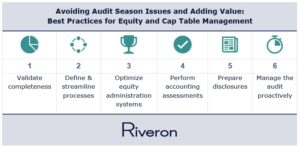
These are the steps that will lead to a more effective equity management process:
Validate completeness of equity transactions:
- Establish a quarterly cadence with the legal team to review new equity issuances, board of director actions, and amendments to governing documents.
- Maintain a centralized inventory of documents including discussions of equity transactions (e.g., Certificate of Incorporation or other governing documents, Board of Directors and Sub-Committee Meeting agendas/notes, executed agreements for financing transactions).
- Identify and maintain an inventory from less-standard sources (e.g., customer, vendor, and/or partnership agreements).
- Formalize and document processes surrounding the flow of information to ensure complete document retention and engagement from accounting.
Define and streamline cap table & accounting processes:
- Establish a structured process around cap table maintenance throughout the year, including the timely recording of any issuances or changes, and exchanging the information with accounting.
- Establish clear roles and responsibilities with respect to ownership of accounting conclusions, including the engagement of external specialists.
- Implement a reconciliation process to validate the equity subledger to general ledger throughout the year.
- Establish journal entry review process, including the identification of expected support packages for each class of transaction.
Optimize equity administration systems:
- Establish clear system ownership and governance by defining roles, permissions, and access to record changes in cap table activity.
- Leverage system functionality to automate processes such as valuation of share-based awards and vesting.
- Identify and maintain an inventory of reporting that supports the financial statement disclosures.
- Validate data inputs and prepare reconciliations between the equity system, general ledger and legal documentation to ensure completeness and accuracy of cap table and equity transactions.
- Document system limitations and establish processes for accounting assessments that require “outside the system” treatment.
Perform accounting assessments:
- Identify and classify unique classes of equity-related transactions and allocate clear ownership of accounting conclusions.
- Prepare technical accounting assessments for each equity-related instrument, leveraging external assistance where required.
- Determine where valuation specialist involvement is required and engage early in the process.
- Record and review journal entries, backed by complete support packages of legal documents, technical accounting assessments and valuation specialist reports.
Prepare disclosures:
- For each class of transaction, identify and document disclosure requirements, including presentation on the face of the financial statements, as technical accounting assessments are performed.
- Prepare a GAAP disclosure checklist to ensure completeness and consistency across reporting periods.
- Establish a process for compiling all the cap table and equity activity and the technical accounting conclusions necessary in order to prepare the financial statements.
- Identify reporting capabilities of equity administration systems, perform validations if required, and retain documentation of reporting that facilitates disclosures.
- Retain organized and version-controlled documentation supporting all narrative and quantitative disclosures.
Manage the audit proactively:
- Engage the auditors early and often throughout the close and audit planning. Highlight processes followed and completeness of documentation to obtain feedback and avoid audit surprises.
- Prepare summary conclusions, highlighting complex or judgmental positions, and facilitate conversations on these positions.
- Assemble comprehensive audit support packages that include fully executed agreements, valuation reports, technical memoranda, and corresponding journal entries, all tied to the general ledger and disclosure schedules.
How Riveron Can Help
As an independent advisory firm, Riveron is deeply entrenched in audit preparation activities and understands the significant scrutiny placed on equity audits. Our experts provide comprehensive, full-scope equity accounting and administration solutions designed to manage risk, accelerate your timeline, and ensure technical compliance this audit season. We partner with management teams to transform chaotic equity processes into clear value drivers by providing:
- Audit readiness & technical accounting: With the expertise to guide your organization before, during, and after the audit, we scope transactions, prepare all necessary technical accounting assessments, and draft comprehensive, auditor-ready support packages and financial statement disclosures.
- Cap table management & optimization: We validate the completeness and accuracy of activity, migrate manual processes to optimized systems, and establish scalable governance processes.
- Valuation services: Our valuation experts prepare 409As and complex instrument valuations that meet the Company’s regulatory and financial accounting requirements.
- Full financial reporting support: We prepare the equity roll-forward, draft footnote disclosures, and validate system outputs to ensure seamless financial statement production.