

Building your investment narrative is paramount when contemplating an IPO process. Ideally beginning 18 months or more prior to your IPO, delivering a consistent message and garnering engagement and trust with the market and investors is critical. Part 2 of the Riveron IPO Readiness series focuses on customizing your investment narrative as it serves as the cornerstone for engaging with key stakeholders – bankers, equity analysts, and potential investors – who ultimately determine the success of your IPO journey. In a recent panel discussion, Riveron industry experts shed light on the pivotal elements of this narrative and the strategic approach required for its development.

Watch the Replay
BUILDING YOUR INVESTMENT NARRATIVE
KEY TAKEAWAY #1
Begin Preparation Early
As the equity capital markets seem poised to reopen, crafting a compelling investment case for public institutional investors will necessitate a fresh approach as investors will be focused on different metrics after the frothiness of the 2021 IPO and SPAC bubble. Setting that groundwork for an IPO should commence well in advance to cultivate engagement and especially trust among critical support groups. These include bankers, equity analysts, and investors – the groups upon which your IPO success hinges. Your narrative must speak in terms investors understand, enabling comparisons with familiar companies while standing out through unique offerings and market position. Creating a comprehensive presentation informs the S-1 filing, but it is not entirely public-facing. Rather, it forms the backbone of how the company presents itself to various stakeholders, ensuring a consistent, quantitative, and qualitative message throughout the IPO process and beyond. The S-1, along with other materials are built off this backbone but are not fully inclusive of all materials in that comprehensive deck.
BUILDING YOUR INVESTMENT NARRATIVE
KEY TAKEAWAY #2
Build Your Case for the Long-Term
A narrative must be comprehensive, detailing not only the problem/solution dynamic, size of the market, and management strength but also provide deeper insights into product development, go-to-market strategies, unit economics, and future roadmaps. Ultimately, what you put out in your S-1 has to stand the test of time, and therefore you must be very careful how you articulate your past and your vision. Many of the KPI’s you discuss will be disclosed quarterly, or at least annually, and you should have confidence in their future trajectory.
Your narrative must:
- Unpack the key investment highlights that make for a compelling and unique value proposition
- Bridge how you have presented the company previously to existing private investors to ensure consistency and continuity in your message
- Encapsulate essential aspects such as your company’s , capital allocation, growth strategy, risk mitigation and management’s depth of experience.
- Align with Wall Street norms regarding things like financial guidance practices, financial metrics nomenclature, and KPIs.
BUILDING YOUR INVESTMENT NARRATIVE
KEY TAKEAWAY #3
Differentiate Your Story
Crafting a compelling investment narrative involves a careful balance of compliance, communication flexibility, quantitative analysis, qualitative insights, and audience understanding to resonate effectively with stakeholders throughout the IPO process. Your narrative should answer fundamental questions (Who, What, When, Where, Why) while also highlighting the uniqueness of your business and its growth potential. It needs to be engaging, interesting, compelling, and informative because your story will last well beyond the IPO. An S-1 must be compliant with SEC rules, and numbers must conform to GAAP, and thus you are limited by those factors in how you articulate the investment case.
- Incorporate Quantitative and Qualitative Elements: The narrative incorporates both quantitative (such as revenue, profitability, and operational metrics) and qualitative elements (such as strength of team, go-to-market strategies, value delivery, and competitive differentiation).
- Understand Investor Perspective: Institutional investors require a clear understanding of how the company intends to create shareholder value, as they typically manage a diverse portfolio, and IPOs are often not core to their work. The narrative must be relatable and comparable to what investors already know, while also differentiating the company from competitors, with whom investors may be deeply familiar.
- Tailor Your Message for Different Cohorts: The narrative must be simple, relatable, and consistent. Tailoring the narrative for different audiences, such as bankers, equity research analysts, and potential public investors, involves understanding their perspectives and limitations on information disclosure. Use caution when divulging sensitive information and build upon existing narratives rather than starting from scratch.
BUILDING YOUR INVESTMENT NARRATIVE
KEY TAKEAWAY #4
Know what to say and when to say it
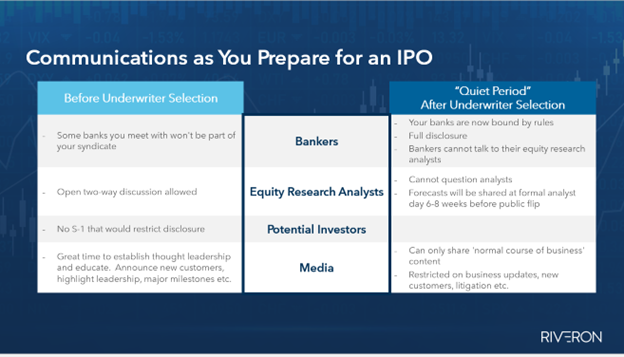
When preparing for an IPO, it is crucial to understand your stakeholders — bankers, research analysts, investors, and the financial media — and the unique needs each has. Before beginning a formal process, while not bound by SEC regulations, discretion is necessary in conversations with potential bankers and analysts, some of whom may not eventually be part of your underwriting syndicate. Once underwriters are selected, quiet period rules apply, creating restrictions for information release. At this point, the chosen banks are bound by confidentiality and will need full disclosure to conduct their diligence. Their research analysts, however, will not be privy to as much information, but will ultimately be furnished with a quarterly forecast model from which they will build their own basis for IPO valuation. This will be published in their research, and thus must be appropriately conservative.
Each cohort has specific wants: bankers desire transparency and a successful branding event, analysts want to build a robust relationship, and investors need reassurance to build confidence in their investment. Careful handling of these relationships is key as the story told will echo through these channels, influencing your company’s perception in the market. Lastly, media engagement becomes highly restricted after banks have been chosen and therefore should start early, seeding messages of thought leadership and branding in line with your projected public image.
Shifting from a private company to a public company often requires a significant adjustment in mindset, from promising best-case scenarios to the practice of under-promising and overdelivering. A key part of this strategy is the development of a reliable forecast model in coordination with your FP&A team. Creating and establishing a ‘beat and raise model’ encourages ongoing shareholder trust. It reflects the company’s awareness of its business risks and the desire to create value over the long-term, as opposed to aggressive forecasting that may enable and encourage long-term private investors and employees to liquidate stock as soon as their lock-up periods expire, which will be viewed skeptically by your new institutional investors.