
/Passle/66b0e16610008cf7be5e944d/MediaLibrary/Images/2026-08-25-17-17-55-805-6a8dce43d5120d632a602537.jpg)
Share:
The private equity market is moving again, but not every portfolio company is ready to move with it. For much of the past several years, PE firms have navigated a slower deal environment marked by higher interest rates, economic uncertainty, and longer hold periods.
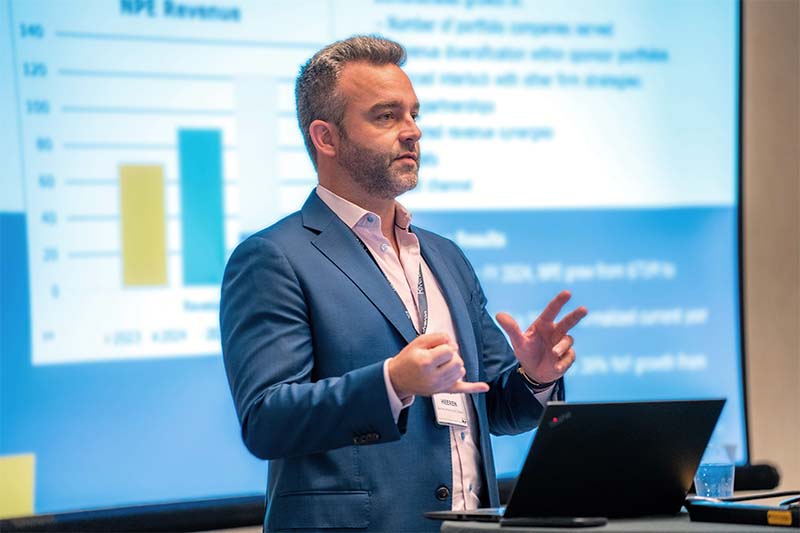
After a Riveron-hosted meeting with nearly 30 middle-market PE firms this summer, we identified recurring trends, beyond just market timing, that point to a more constructive deal environment and a growing focus on exit readiness, data, technology, finance talent, and operational support. Together, these trends suggest that sponsors are increasingly focused on what they can control: creating value throughout the hold period and preparing portfolio companies to act when an exit opportunity arises.
Sponsors can’t control when the ideal exit window will open, but they can control whether their portfolio companies are ready when it does.
Here are the six trends that stand out as signals of how sponsors are approaching the next phase of private equity value creation:
| PE Trend 1 | PE Trend 2 | PE Trend 3 | PE Trend 4 | PE Trend 5 | PE Trend 6 |
| The market is moving again, and firms with aging holds are feeling it | Data organization is the #1 pre-exit priority | AI is moving from a boardroom talking point to a practical advisory need |
The CFO talent shortage is structural – firms are actively looking for workarounds
|
Longer hold periods are changing the value creation playbook |
Sponsors are consolidating advisory relationships
|
1. The market is moving again, and firms with aging holds are feeling it
Sponsors are seeing increased deal flow, renewed interest in industrial businesses, and growing pressure to prepare portfolio companies held longer than originally anticipated. Firms that have delayed operational improvements may find themselves scrambling to prepare for a sale while those that invested early are better positioned to move quickly.
For sponsors with aging portfolio companies, renewed deal activity increases the urgency to address operational gaps now rather than waiting until a transaction is underway. And one challenge is emerging as a particularly significant barrier to exit readiness: disorganized financial data and reporting.
2. Data organization is the #1 pre-exit priority
As sponsors prepare portfolio companies for future transactions, many are realizing that strong financial performance isn’t enough. Buyers increasingly expect companies to demonstrate consistent reporting, reliable forecasts, and clear visibility into the business before diligence begins.
Sponsors want financial data and reporting infrastructure that help management make better decisions throughout the hold period and give buyers a clean, credible view of the business at exit. Organizing that data 18 to 24 months before an anticipated sale can improve operational decision-making while reducing friction during diligence.
The demand is growing for integrated finance data architectures, forecasting capabilities, and technology modernization can also help strengthen the CFO function and create lasting enterprise value.
3. AI is moving from a boardroom talking point to a practical/real-world advisory need
Every sponsor we talked to has had the AI conversation, and most have had it several times, but many are starting to get skeptical because the promises have outpaced the results.
The market is naturally separating into two camps: firms selling AI as a vision, and firms who can show up and deploy it. The gap between those two things is where a lot of money and time has been lost over the past two years.
What we’re hearing is that sponsors don’t need another AI roadmap; they need someone to come into a portfolio company, look at what’s actually there —the data, the systems, the team — and tell them what’s worth doing and what isn’t. And then do it.
The use cases gaining real traction aren’t the flashy ones. Where we’re seeing meaningful results is inside the order-to-cash process, specifically quoting and bidding. Most mid-market portfolio companies have the same problem. The inputs needed to build an accurate quote (labor rates, material costs, lead times, engineering specs, margin targets) live in five different systems, three spreadsheets, and the head of someone who’s been there twenty years and is probably thinking about retirement.
Order to cash touches every level of the organization, such as sales, operations, finance, and customer service, and those handoffs between the departments are exactly where things break down. AI is exceptionally good at that problem because it extracts data from disparate systems, surfaces the right inputs at the right moment, and encodes the judgment that used to live only in a long-tenured employee’s head into a process anyone can execute consistently. The tribal knowledge doesn’t leave when the person does.
The downstream effect is permanent because faster quotes mean faster POs, faster invoicing, and faster cash collection. The cash conversion cycle compresses — not as a one-time win but as a new baseline.
The people story matters too, and when quoting runs on AI, the estimator who spent half their day assembling inputs is now spending that time on what the data means — margin, pricing strategy, where the business is leaving money on the table. For the first time, they have space to think, and that’s a different organization than the one you bought.
4. The CFO talent shortage is structural – firms are actively looking for workarounds
An ongoing shortage of experienced CFO and FP&A talent persists. Many sponsors described portfolio companies where finance leaders are stretched beyond their capabilities or controllers have assumed responsibilities traditionally handled by seasoned CFOs. Building scalable reporting processes, improving forecasting, and establishing financial discipline require leadership experience that remains difficult to find.
As a result, interim and fractional finance executives are increasingly viewed as strategic resources rather than temporary solutions. For sponsors strengthening the oCFO with experienced interim leadership can help establish scalable finance operations, improve visibility, support value creation initiatives, and prepare the organization for an eventual transaction.
5. Longer hold periods are changing the value creation playbook
Instead of concentrating advisory support around acquisitions and exits, firms are investing throughout the hold period to improve performance and build stronger businesses.
For many sponsors, the most meaningful value-creation opportunities may emerge in the middle years of ownership, making investments in finance processes, technology infrastructure, and performance management ongoing priorities rather than last-minute exit-preparation exercises. Longer investment horizons are also changing how sponsors approach transforming technology, finance modernization, and performance improvement—shifting them from transaction-driven projects to ongoing value-creation priorities.
6. Sponsors are consolidating advisory relationships
Many firms described a shift toward deeper, portfolio-wide advisory relationships.
Rather than engaging different providers for individual projects, sponsors increasingly prefer strategic partners who understand their investment philosophy, operating model, and expectations across multiple portfolio companies.
When a new provider enters each portfolio company, institutional knowledge can be lost and teams must repeatedly spend time learning how the sponsor operates. Advisors who already understand a sponsor’s portfolio can onboard more quickly, apply lessons learned across investments, and deliver more consistent outcomes throughout the investment lifecycle.
For sponsors, deeper advisory relationships can preserve institutional knowledge across the portfolio, reduce onboarding time, and create greater consistency in how operational challenges are addressed from acquisition through exit.
Looking ahead
Although macroeconomic uncertainty remains, our conversations suggest the middle-market private equity landscape is entering a more constructive phase. Sponsors are seeing increased deal activity, but they recognize that market timing alone will not determine successful outcomes.
The broader takeaway across these six trends is that value creation and exit readiness are increasingly connected. Investments in finance leadership, trusted data, scalable technology, and operational capabilities can improve portfolio company performance during the hold while positioning the business to act when transaction opportunities emerge.
Sponsors can’t determine exactly when the next exit window will open, but those that build operational readiness throughout the hold period can put their portfolio companies in a stronger position when it does.
Although macroeconomic uncertainty remains, our conversations suggest the middle-market private equity landscape is entering a more constructive phase. Sponsors are seeing increased deal activity, but they recognize that market timing alone will not determine successful outcomes.
https://riveron.com/solutions/maximizing-exit-effectiveness/
Sign Up for the Newsletter
Lorem ipsum dolor sit amet consectetur. At nullam dignissim et facilisis ipsum volutpat dui.
Contact us
Lorem ipsum dolor sit amet consectetur. At nullam dignissim et facilisis ipsum volutpat dui. Velit eu amet odio dignissim nunc nisl.


More Insights



Hamish de Freitas Recognized as a Notable Leader in Accounting, Consulting & Law by Crain’s New York Business

Rethinking LMEs: Financial Engineering Without Operational Reform Is a Path to Value Destruction

Contact us
Continue the conversation. Reach out to Riveron’s team of professionals to explore how we can provide the clarity and insight to solve your organization’s most pressing challenges.