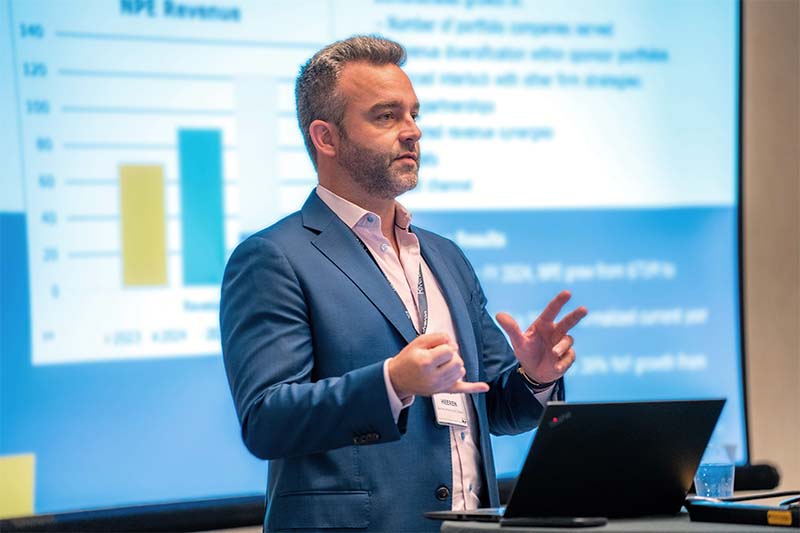


Tip # 2 for evaluating technology: Many software solutions have the same basic capabilities, so cast those aside, and spend the demo time on the important information.
For businesses navigating acquisitions, technology enablement is critical for guiding the path forward, making operations more streamlined and efficient, and achieving long-term success. As companies grow and become more complex, their existing technology landscape often will not scale with them or meet all their latest requirements. Additionally, when businesses merge, it may result in multiple disparate legacy systems, which can fail to support growth strategies or be costly for teams to manage. Riveron’s Brent Fisher discussed these concepts with The Common Sense Professional podcast hosts Marie Weise and Chuck Ingram, including how business leaders can leverage technology following an acquisition while adopting a people-centric approach.
Check out the highlights[1] below, or listen to the full episode:
The Common Sense Professional (TCSP) Podcast Hosts: What is the number-one problem right now in the marketplace around why companies aren’t doing a great job of figuring out the path forward post-acquisition?
Brent Fisher (BF): Before companies get to technology, they have to think about people and process first. This is the number-one aspect of integrating organizations: people inform process and technology enables process. We don’t implement technology for technology’s sake or just to make a change from what the company has done in the past.
TCSP: What are some other common denominators that you’re seeing?
BF: Over the last year, we have had a record number of deals in the private equity market. There was some pent-up demand coming out of the pandemic, acceleration with IPOs in the stock market, and acquisitions, so there is a lot of activity and change happening.
When helping clients pre-acquisition as they’re evaluating a company, we really have to look at the landscape and organizational set-up. If we think about it from an IT operations perspective; who are the people coming over? What roles do they have? How are they going to fit into the organization? We have to start getting ahead of these challenges and ask whether everything makes sense from a people perspective.
Companies have to take a step back and think about their whole investment, period. What was the thesis in acquiring this company? What’s the playbook? Companies that navigated acquisitions well have a 100-day plan coming right after the acquisition. They’re thinking about all these things along with the risks. They consider where they have synergies as they integrate businesses and execute on that. This is the tough part.
At Riveron, we evaluate companies’ business applications and how they’re using technology. We help companies decide what technology is staying and what’s going to be removed.
TCSP: Do you see a collision between what software companies say about their technology and what actually meets the needs of firms?
BF: It’s a challenging, complex landscape. Today, your mid-market company may have 10 to 12 applications that they’re running to operate a business. What we’re finding is that, following the pandemic and through remote work, as well as the acceleration of the cloud, new tools are popping up. There are very pointed, very industry-driven solutions that businesses can use to their advantage. In the past, maybe companies had a monolithic system that held everything, but now there are a lot of best-of-breed solutions.
At Riveron, we’re agnostic to the set of tools. We help clients step back and focus on what’s important rather than the bells and whistles and dazzling demos that no one knows how to evaluate. We want to focus on three or four key business processes that are unique tothe business and have the potential to transform the company. We help clients cut through the things that software companies say and help them really understand how the software can help them.
TCSP: Do you have three quick tips for companies selecting technology? What is your common-sense advice?
BF: Sometimes, a demo of a technology application becomes just a reactive process—throwing people in a room who aren’t prepared, perhaps because they don’t know how to score the software and aren’t sure what they’re actually seeking to gain from the technology. Most of the time, when you get people from different business units or department functions together for a demo, they’ve never sat down previously and talked as a group about what they want and what the future needs to look like. In advance of a demo, here’s what teams can do:
- Before you start looking at any technology solution, get the key stakeholders together and break the discussion down by business process, current pains, requirements to scale the business, and desired future state. Understand why you are even embarking on this journey for a new system. There has to be some key reason.
- During demos, make it clear to the software provider which specific things they need to show. Many software solutions have the same basic capabilities, so cast those aside, and spend the demo time on the important information.
- Decide how you’re going to evaluate your technology options in advance and use that to guide your decisions.
[1] Excerpts edited for brevity and clarity. Listen to the full episode here.
Want to get additional insights direct to your inbox?
Subscribe to Riveron Insights and get relevant news and trends shaping the world of finance, accounting, and operations.
CONNECT WITH AN EXPERT