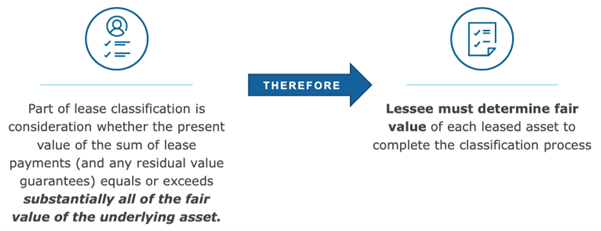
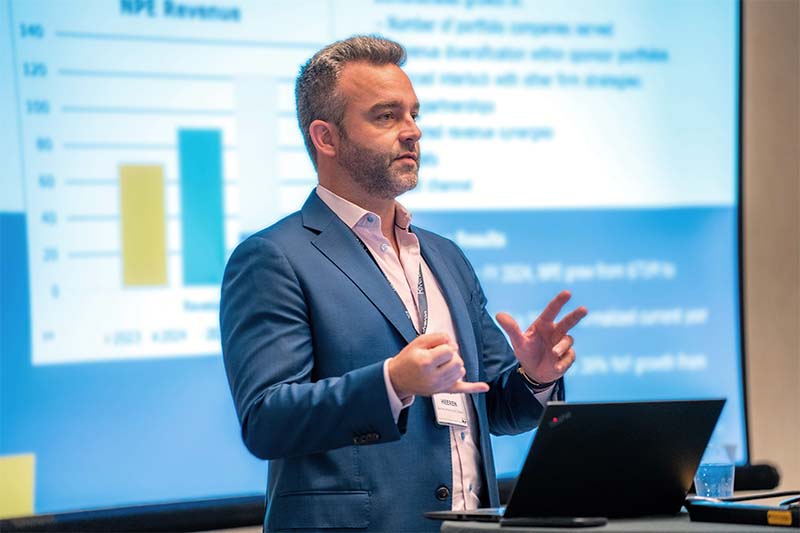
Through a virtual event, Riveron accounting and finance experts provided an overview of the complexities associated with the lease accounting standard ASC 842. For private companies with leased assets in the process of implementing these newer lease accounting standards, there are two primary technical application pain points: (1) considering the discount rates used to calculate lease liabilities and (2) determining fair value of certain leased assets. As private companies seek to adopt ASC 842 in a compliant and seamless manner, here are some key factors to keep in mind:
A private company has three options when choosing a lease discount rate: the rate implicit in the lease, the risk-free rate, or the company’s incremental borrowing rate (IBR).
When determining discount rates, lessors and lessees must first use the rate implicit in the lease, if available. From a practical standpoint, implicit rates are not explicitly stated in leases but can be inferred if certain details are presented in the lease agreement. Unfortunately, this often is not the case because the information necessary to calculate the implicit rate may disclose the lessor’s profit—and typically lessors are not willing to share this information.
A risk-free rate is the rate that investors would expect to earn from an investment that carries zero risk over a defined period of time. Typically, US-based companies use a US treasury rate for a comparable term. The pros of using a risk-free rate are that they are publicly available and easy to obtain, require no further investment, and are easy to audit. However, in most cases a risk-free rate will be much lower than the IBR. Companies with large lease portfolios containing longer-term leases may discover that using a lower risk-free rate can have a material impact of increasing the size of their lease liabilities. Furthermore, any companies that go public or are acquired by a public company will be forced to transition to the IBR.
Nearly all lessee contracts will use the IBR. The Financial Accounting Standards Board (FASB) defines the IBR as “the rate of interest that a lessee would have to pay to borrow on a collateralized basis over a similar term an amount equal to the lease payments in a similar economic environment.”
In other words, the IBR is the interest rate that a company would pay to borrow funds equal to the lease payments over the lease term, assuming that the loan is also collateralized by the underlying assets.
IBRs are driven by company-specific inputs, such as a specific debt structure credit rating, which results in a more accurate rate for discounting leases. The IBR is typically higher than the risk-free rate, which means IBRs usually result in a lower lease liability. Lastly, using the IBR requires less re-work for companies when planning to go public, or if an organization is acquired by a public company.
The main challenge with using IBRs is that most private companies lack robust treasury departments, which inhibits access to certain inputs that are necessary in calculating the IBR, such as credit ratings yield curves, debt, and liquidity ratios. These companies will need to procure third-party expertise and support, which can be time consuming and costly. Additionally, IBRs must be updated quarterly, or at least annually, depending on a company’s reporting requirements. Each time a company engages with external experts or undergoes complex accounting processes, it is an added expense.